Cosmology

Global view of the Orion A molecular cloud (Image ESO/VISION survey)

An article published in the journal “Astronomy & Astrophysics” describes the most detailed view of the molecular cloud called Orion A, one of the two giant molecular clouds in the Orion molecular cloud complex. A team of researchers created it by putting together infrared images obtained from the VISION (Vienna Survey in Orion) survey with ESO’s VISTA telescope revealing many young stars and other objects normally hidden within dust clouds.

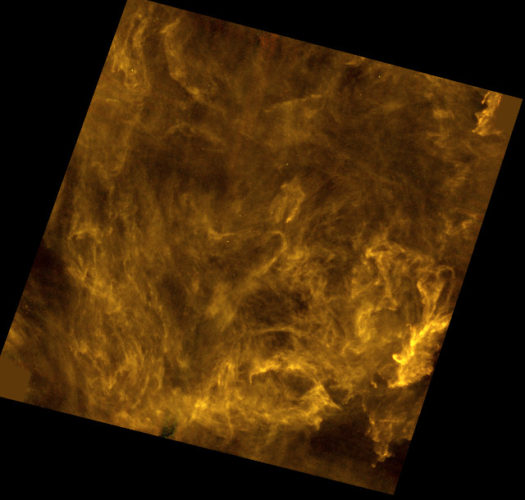
Interstellar filaments in Polaris (Image ESA and the SPIRE & PACS consortia, Ph. André (CEA Saclay) for the Gould’s Belt Survey Key Programme Consortium, and A. Abergel (IAS Orsay) for the Evolution of Interstellar Dust Key Programme Consortium)

ESA has published a new picture of the network of interstellar filaments seen by the Herschel Space Observatory in the space around Polaris, the North Star, which is actually a multiple system. For this reason also known as Polaris Flare, it’s an interstellar cloud in which filaments formed in which there are gas and dust visible especially at infrareds.

VIPERS survey's map (Image B. Granett, L. Guzzo & the VIPERS Collaboration)

In recent days, two groups of researchers have published their cosmic maps. The VIPERS project used the VIMOS spectrograph installed on ESO’s VLT (Very Large Telescope) to examine 90,000 galaxies and create a wide and highly accurate three-dimensional map of the distant universe. The Pan-STARRS project used the telescope at Haleakala, Hawaii, to obtain repeated images of three-quarters of the visible sky and create a map of billions of space objects.

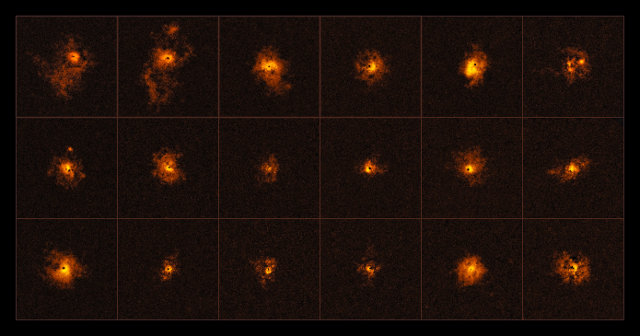
18 of the quasars studied (Image ESO/Borisova et al.)

An article to be published in “The Astrophysical Journal” describes an investigation into the glowing gas clouds around distant quasars. An international team of astronomers led by a group at the ETH (Swiss Federal Institute of Technology) in Zurich, Switzerland, used the MUSE instrument mounted on ESO’s Very Large Telescope (VLT) to look at very distant galaxies that are active, of the type called quasar, and discovered that the gas halos that surround them are more common than expected.

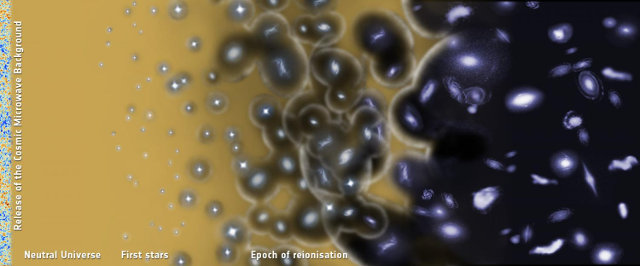
Artist's impression of a portion in the timeline of the Universe, around the epoch of reionization (Image ESA – C. Carreau)

Two articles published in the journal “Astronomy and Astrophysics” describe the latest updates regarding the analysis of the data collected by ESA’s Planck Surveyor space probe between 2009 and 2013. The latest results show that the first stars started forming about 700 million years after the Big Bang, about 150 million years later than earlier analyzes indicated.