Cosmology

Simulation of the large-scale structure of the universe (Image Nico Hamaus, Universitäts-Sternwarte München, courtesy of The Ohio State University)

An article accepted for publication in the journal “Physical Review Letters” describes a research on the distribution of matter in the universe made in a way different from usual. An international team of researchers studied cosmic voids as if they were photographic negatives from which they could get information about ordinary matter, dark energy and dark matter.

Various reconstructions of the gravitational waves detected by the LIGO experiment (Image courtesy LIGO experiment)

During a press conference at the American Astronomical Society meeting in San Diego, the second detection of gravitational waves from the merging of two black holes by the LIGO experiment was announced. It is a different event from the first, historic, one announced on February 11, 2016: this time the merger took place about 1.4 billion years ago and was detected on Earth on December 26, 2015. The event is also described in a article published in the journal “Physical Review Letters”.

The galaxy UGC 9391 seen by the Hubble Space Telescope. Cepheid variable are in red circles, a type Ia supernova is marked by a blue cross (Image NASA, ESA, and A. Riess (STScI/JHU))

An article accepted for publication in “The Astrophysical Journal” describes a research based on observations made with the Hubble Space Telescope that suggests that the universe is expanding at a faster rate than expected. A team of astronomers led by Nobel laureate Adam Riess measured the distance of stars in nineteen galaxies with the best accuracy ever achieved to obtain this surprising result.

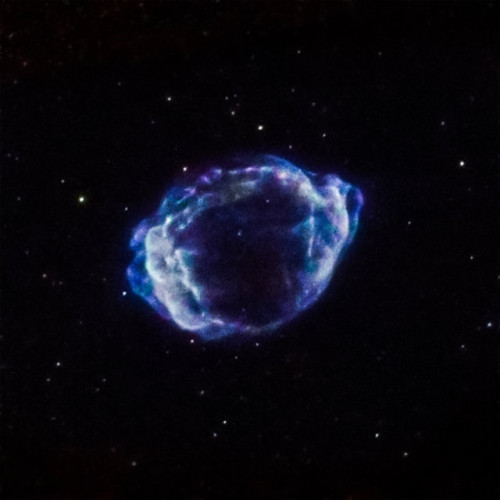
The supernova G1.9+0.3 (Image NASA/CXC/CfA/S. Chakraborti et al.)

An article published in “Astrophysical Journal” describes the analysis of the supernova remnant G1.9+0.3, the youngest observed in the Milky Way. A team of astronomers from Harvard University used data collected by NASA’s Chandra space telescope and the VLA radio telescope to find evidence that it’s an explosion triggered by the merger of two white dwarfs, what is called a Type Ia supernova.

Map of voids and galaxy superclusters around the Milky Way (Image Richard Powell)

An article published in the journal “Astronomy & Astrophysics” describes the discovery of what was called the BOSS Great Wall, a supercluster more than a billion light years long and between 4.5 and 6.4 billion light years from the Earth. With an estimated mass of 10,000 times that of the Milky Way, it’s the largest supercluster discovered so far.