Cosmology

A portion of space simulated by the Illustris project showing the distribution of dark matter (Image courtesy Markus Haider / Illustris collaboration)

An article published in the journal “Monthly Notices of the Royal Astronomical Society” describes a research on the distribution of matter in the universe. According to the results 20% of ordinary matter is contained in the so-called cosmic voids and galaxies are only 1/500th of the volume of the universe. A team led by Dr Markus Haider of the Institute of Astro and Particle Physics at the University of Innsbruck in Austria, has used simulations of the Illustris project to reach these conclusions.

Field of view of the Parkes radio telescope. On the right two zoom-ins and at the bottom an image from the Subaru telescope (Image courtesy D. Kaplan (UWM), E. F. Keane (SKAO))

An article published in the journal “Nature” describes research that has uncovered the place of origin of a Fast Radio Burst (FRB). These radio signals that last only a few milliseconds are picked up with no phenomenon that might warn about its arrival. An international team of astronomers used observations made by optical and radio telescopes to trace the origin of this phenomenon.

Artistic representation of the WFIRST Space Telescope (Image NASA/GSFC/Conceptual Image Lab)

NASA announced the approval of a new astrophysics mission based on a space telescope called WFIRST (Wide-Field Infrared Survey Telescope). It’s a next-generation Instrument for a long-term project since it will be probably launched around the middle of next decade. It will have a mirror as large as Hubble’s but a field of view a hundred times wider to investigate even better on the secrets of the universe.

The gravitational waves detected by LIGO (Image courtesy LIGO)

In Washington, D.C. a press conference was held to announce that the LIGO experiment found the gravitational waves predicted by Albert Einstein’s theory of general relativity. Two blacks holes about 1.3 billion light years from Earth merged as a result of a collision emitting those waves.

LIGO (Laser Interferometer Gravitational-Wave Observatory) is an instrument designed specifically to detect gravitational waves. It was created in a collaboration between Caltech (California Institute of Technology) and MIT (Massachusetts Institute of Technology) with funding from the American NFS (National Science Foundation).

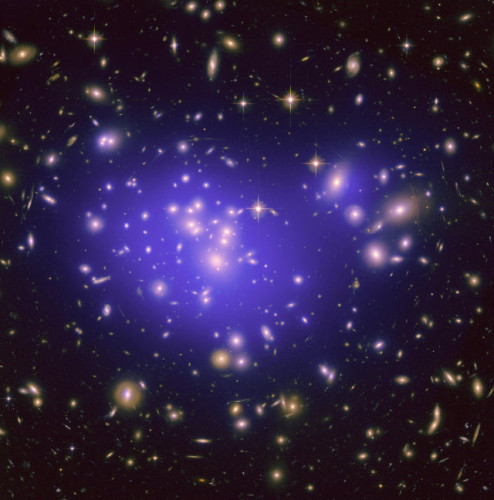
The Abell 1689 galaxy cluster

An article published in the journal “Physical Review Letters” offers clues about the link between the internal structure of a galaxy cluster and the dark matter environment surrounding it. The study of dark matter is complex because it can only be done indirectly due to the fact that we can’t detect it directly. Until now, scientists believed that the greater the mass of a cluster the greater the amount of dark matter in its environment. This new research suggests that things are more complicated.