Cosmology

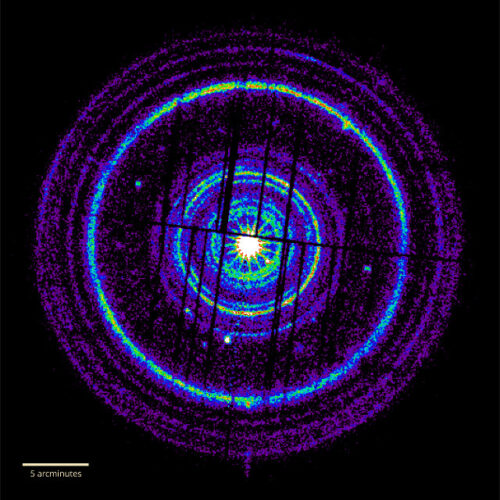
The concentric rings generated by the GRB221009A gamma-ray burst as seen by the XMM-Newton space telescope (Image ESA/XMM-Newton/M. Rigoselli (INAF))

A special issue of “The Astrophysical Journal Letters” is focused on the gamma-ray burst cataloged as GRB221009A, indicated since the first estimates of its characteristics as the gamma-ray burst of the century. Various teams of researchers conducted various types of analyzes of the data collected by many instruments that detected the emissions from GRB221009A and the so-called afterglow, meaning from the residues of its emissions, in several electromagnetic bands. The wealth of data indicates that this is the most powerful gamma-ray burst ever observed and offers new insights into these extremely energetic phenomena. In this case, it was a long gamma-ray burst, probably generated by the collapse of the core of a massive star and the subsequent birth of a black hole.

A scheme of the passage from the universe full of neutral hydrogen and dark to the bright one following the epoch of reionization

An article published in the journal “Astronomy & Astrophysics” reports the identification of a group of primordial galaxies that could be among the ones that contributed to the reionization of the universe, making it go from dark to bright. A team of researchers coordinated by the Italian National Institute of Astrophysics used observations conducted with the James Webb space telescope within the GLASS-JWST program to study 29 very distant and therefore ancient galaxies. The examination of those galaxies’ physical characteristics led the researchers to conclude that 80% of them contributed significantly to reionization.

The map of the polarized microwave emission measured by the QUIJOTE experiment

Six articles published in the journal “Monthly Notices of the Royal Astronomical Society” report various aspects of the most accurate mapping of the polarization of the Milky Way’s microwave emissions. This provides a map of the galactic magnetic field thanks to the QUIJOTE (Q-U-I JOint TEnerife) experiment. The QUIJOTE Collaboration presented what is only the initial set of scientific papers in a survey that complements the ones obtained from other missions such as the one from the Planck Surveyor satellite. These results are useful to obtain new information on the structure of the Milky Way’s magnetic field and to understand the energetic processes that occurred soon after the birth of the universe.

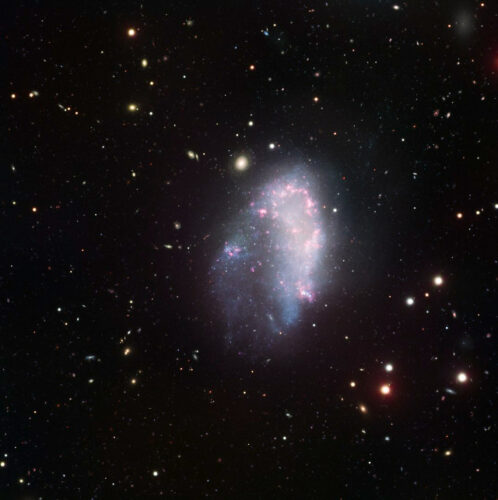
NGC 1427A, one of the dwarf galaxies in the Fornax cluster that appear to be devoid of dark matter halos (Image ESO)

An article published in the journal “Monthly Notices of the Royal Astronomical Society” reports the results of a study of the distribution and morphology of the dwarf galaxies of the Fornax cluster which concludes that they are free of dark matter halos. A team of researchers coordinated by the German University of Bonn and the Scottish University of Saint Andrews examined those dwarf galaxies to see how perturbed they are by gravitational tides generated by nearby galaxies.

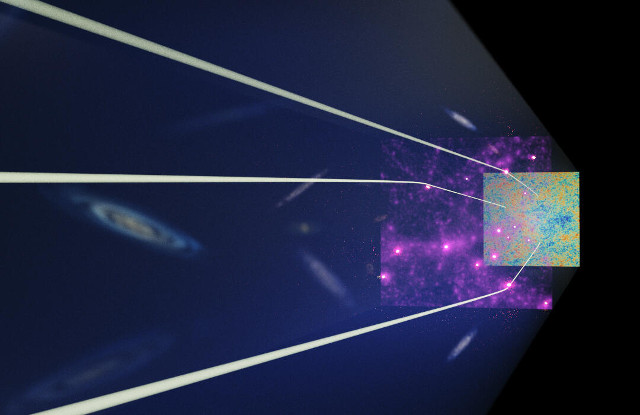
An artistic representation of the combination of the observations obtained in the HSC-SSP survey and the cosmic microwave background data collected by the Planck Surveyor space probe

An article published in the journal “Physical Review Letters” reports the results of an analysis of dark matter distribution around 1.5 million primordial galaxies. A team of researchers led by Hironao Miyatake of the Japanese University of Nagoya used observations conducted with the Subaru telescope and analyzed data collected by the Planck Surveyor space probe to detect distortion of the cosmic microwave background (CMB).

The results of this study show fluctuations in dark matter distribution in the early universe that led to inhomogeneity in the aggregation of ordinary matter that formed galaxies. That aggregation is lower than predicted by the Lambda-CDM model, the one that currently best describes the observations. The uncertainty lies in the difficulty of obtaining precise results in examining very distant galaxies.