
Cosmology

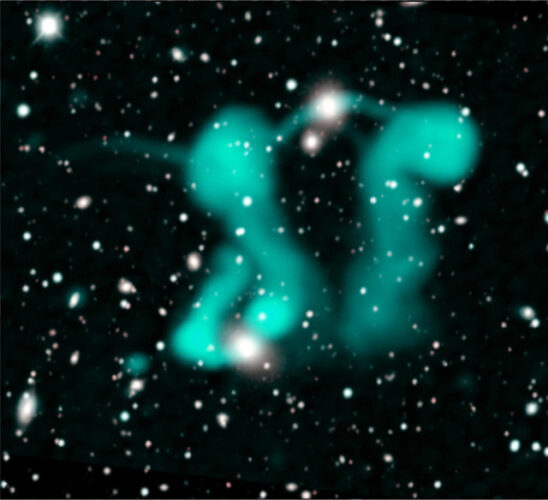
The dancing ghosts seen by ASKAP

An article accepted for publication in the journal “Publications of the Astronomical Society of Australia” reports the first results of the EMU (Evolutionary Map of the Universe) survey, which allowed to discover several objects and phenomena. One of those phenomena is made by strange clouds of electrons surrounding two galaxies about a billion light-years from Earth. This survey was conducted using the ASKAP radio telescope and led to the cataloging of about 220,000 sources including the electron clouds that were compared to dancing ghosts due to their curious shape.

An article published in “The Astrophysical Journal Letters” reports a model of supermassive black hole formation that explains the rapid growth of the ones observed in the early universe. Wei-Xiang Feng, Hai-Bo Yu, and Yi-Ming Zhong propose a model in which the so-called seeds from which these gigantic black holes are formed are generated by a halo of self-interacting dark matter. According to this model, the collapse that forms the seed is accelerated by baryonic matter, common matter, a unified scenario between the two types of matter.

The galaxy NGC1052-DF2 (Image NASA, ESA, Z. Shen and P. van Dokkum (Yale University), and S. Danieli (Institute for Advanced Study))

An article published in “The Astrophysical Journal Letters” reports a precise measurement of the distance of the galaxy NGC1052-DF2 that was used to confirm that it’s almost devoid of dark matter, a notable anomaly. A team of researchers led by Pieter van Dokkum of Yale University used the Hubble Space Telescope to observe the red giants on the outskirts of NGC1052-DF2 using them as “standard candles” taking advantage of the fact that they all reach the same peak in brightness. Understanding why so few of the gravitational effects attributed to dark matter are detected in this galaxy may offer new clues to its nature.

The CHIME radio telescope (Photo courtesy CHIME)

At the 238th meeting of the American Astronomical Society (AAS), held in recent days, Researchers presented the results of fast radio bursts detections made using the CHIME radio telescope between July 25, 2018, and July 1, 2019, the first year of research with this instrument. Researchers from the CHIME collaboration detected 535 fast radio bursts including 61 bursts from 18 known repeating sources. The catalog presented on this occasion considerably expands the number of known fast radio bursts offering a lot of new information on these still mysterious phenomena. The differences between the characteristics of single and repeating bursts indicate even more that there are at least two mechanisms that produce them.

Deep field image (Image Dark Energy Survey/DOE/FNAL/DECam/CTIO/NOIRLab/NSF/AURA Acknowledgments: T.A. Rector (University of Alaska Anchorage/NSF’s NOIRLab), M. Zamani (NSF’s NOIRLab) & D. de Martin (NSF’s NOIRLab))

29 articles report various aspects of the results of a major cosmological research on the largest sample of galaxies – 226 million of them – ever observed to produce the most accurate measurements of the composition and growth of the universe. More than 400 scientists from the DES (Dark Energy Survey) Collaboration used images captured by the Dark Energy Camera in the first three years of the program, which started in 2013, to obtain results. The goal is to improve our knowledge of the universe, in particular, the nature of dark matter and dark energy.