Launches

The Psyche space probe blasting off atop a Falcon Heavy rocket (Image NASA TV)

A little while ago, NASA’s Psyche space probe blasted off atop a SpaceX Falcon Heavy rocket from the Kennedy Space Center. After just over an hour, it successfully separated from the rocket’s last stage and set off on its route that will take it into deep space, towards asteroid 16 Psyche, which it will reach towards the end of July 2029 to study its structure composed mainly of iron-nickel.

Within the asteroid belt between Mars and Jupiter and right now about 3.6 billion kilometers away from Earth, asteroid 16 Psyche is one of the largest known. It’s an M-type asteroid, the type with the highest metal content. It has an irregular shape with a maximum length of almost 280 kilometers, which brings it close to the size of a dwarf planet.

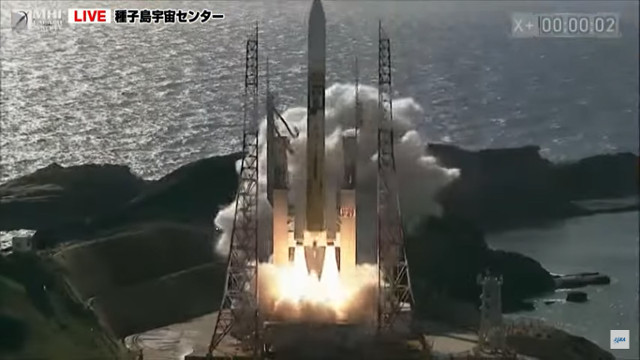
The XRISM space telescope and the SLIM Moon lander blasting off atop an H-IIA rocket (Image courtesy JAXA)

A few hours ago, the Japanese XRISM space telescope and the SLIM Moon lander were launched from the Tanegashima space center atop an H-IIA rocket. After just over 14 minutes, XRISM separated from the rocket’s last stage and after about 48 minutes, SLIM did the same. XRISM will reach low Earth orbit, where it will position at an altitude of approximately 550 kilometers. SLIM started a much longer journey.

SpaceX's Crew Dragon Endurance spacecraft blasting off atop a Falcon 9 rocket in its Crew-7 mission (Image NASA TV)

A little while ago, SpaceX’s Crew Dragon Endurance spacecraft blasted off atop a Falcon 9 rocket from the Kennedy Space Center in its Crew-7 or SpaceX Crew-7 mission. After almost exactly twelve minutes, it successfully separated from the rocket’s last stage and went en route to carry out its mission. This is the 7th crewed mission of the Crew Dragon spacecraft within the normal rotation of the International Space Station crew. This is also the third mission for the Endurance. The launch takes place a day late because it took longer than expected to check the status of some valves of the life support system carried out after some of those of another Crew Dragon started corroding.

The Progress MS-24 cargo spacecraft blasting off (Image NASA TV)

A few hours ago, the Progress MS-24 spacecraft blasted off atop a Soyuz-2.1a rocket from the Baikonur Cosmodrome in Kazakhstan. After about nine minutes it successfully separated from the rocket’s last stage and was placed on its route. The cargo spacecraft began its resupply mission to the International Space Station also called Progress 85 or 85P. In this mission, the route used is the one that requires about two days.

The Luna 25 lander blasting off atop a Soyuz-2.1b (Image courtesy Roscosmos)

A few hours ago, the Luna 25 lander blasted off atop a Soyuz-2.1b rocket from the Russian Vostochny Cosmodrome. After about an hour, the Fregat-M last stage pushed the vehicle to leave Earth orbit, performing the maneuver called in jargon TLI (Tras Lunar Injection) which will take it towards the Moon, where it will land near the south pole, near the Boguslavsky crater.

The Luna 25 mission is the first of the Luna-Glob program, which began in the 1990s with the ambition to reprise the Soviet Luna program and develop it in a way that wasn’t possible in the 1970s. For this reason, the name is Luna 25, considering it the follow-up mission to the 1976 Luna 24.