Launches

The Soyuz MS-23 spacecraft blasting off atop a Soyuz-2.1a rocket (Image NASA TV)

A few hours ago, the Soyuz MS-23 spacecraft blasted off atop a Soyuz-2.1a rocket from the Baikonur Cosmodrome, Kazakhstan. After about nine minutes it successfully separated from the rocket’s last stage and was placed on its route, which requires about two days of journey. It replaces the damaged Soyuz MS-22 as a vehicle for the return of its three crew members: Dmitri Petelin, Frank Rubio, and Sergey Prokopyev. This is the solution chosen by the Russian Roscosmos space agency after having established the impossibility of using the Soyuz MS-22 for the return journey with a crew on board in safety conditions.

The Progress MS-22 spacecraft blasting off atop a Soyuz-2.1a rocket (Image NASA TV)

A few hours ago, the Progress MS-22 spacecraft blasted off atop a Soyuz-2.1a rocket from the Baikonur Cosmodrome in Kazakhstan. After about nine minutes it successfully separated from the rocket’s last stage and was placed on its route. The cargo spacecraft began its resupply mission to the International Space Station also called Progress 83 or 83P. In this mission, the route used is the one that requires about two days.

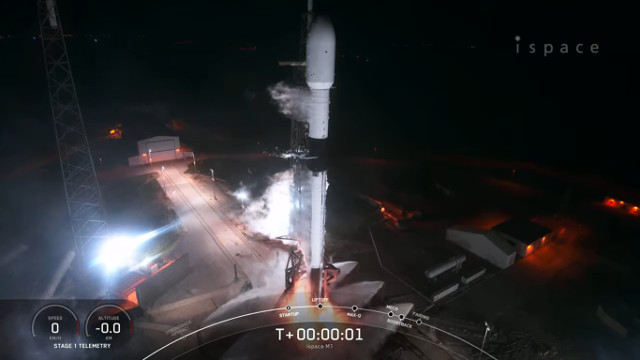
The Hakuto-R Moon lander and the Lunar Flashlight nanosatellite blasting off atop a Falcon 9 rocket (Image SpaceX)

A little while ago, ispace’s Hakuto-R Moon lander and NASA’s CubeSat-class nanosatellite Lunar Flashlight blasted off atop a Falcon 9 rocket from Cape Canaveral. After about 46 minutes, Hakuto-R successfully separated from the rocket’s last stage, and about 7 minutes later, Lunar Flashlight separated as well. Hakuto-R also carries two small rovers built by the United Arab Emirates and Japan. The route of what is called Hakuto-R Mission 1 will take about five months to get the lander to the Moon, where it will attempt a landing while the nanosatellite Lunar Flashlight will enter lunar orbit in about four months in search of water ice on its surface.

The Shenzhou 15 mission blasting off (Photo courtesy (Xinhua/Li Gang)

A confirmation has arrived that three Chinese taikonauts from the Shenzhou 15 mission reached the Chinese space station Tiangong with an automated docking maneuver. They blasted off about seven hours earlier on a Long March-2F rocket from the Jiuquan Satellite Launch Center. They form the fourth crew of the Chinese space station and will remain there for about six months, the standard duration for a mission.

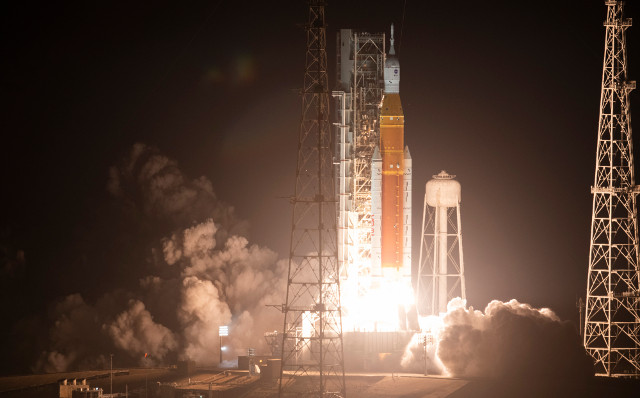
The Orion spacecraft blasting off atop the SLS to start the Artemis I mission (Photo NASA/Joel Kowsky)

A little while ago, NASA’s Orion spacecraft separated from the last stage, called the ICPS (Interim Cryogenic Propulsion Stage), of the Space Launch System (SLS), which blasted off almost two hours earlier from the Kennedy Space Center. The Orion entered the trajectory that will take it into the Moon’s orbit to carry out its mission which will last about 25 days. This is the first launch for the SLS and for the Orion in its full configuration. The ICPS also has the secondary mission of putting some CubeSat-class nanosatellites into orbit.