Launches

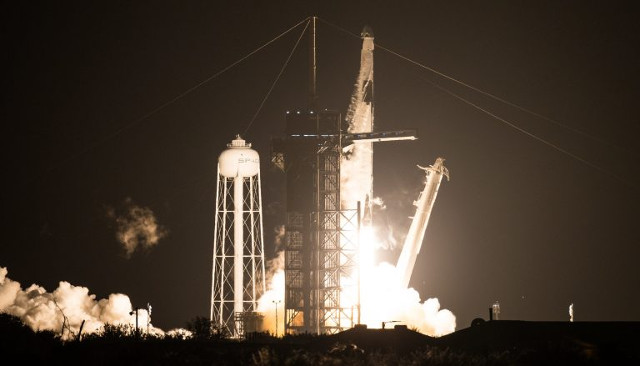
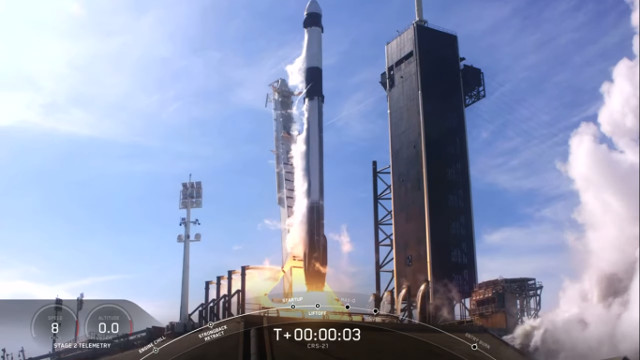
SpaceX's Dragon 2 spacecraft blasting off atop a Falcon 9 rocket (Image courtesy SpaceX)

A little while ago the SpaceX Dragon 2 spacecraft blasted off atop a Falcon 9 rocket from Cape Canaveral in its CRS-21 (Cargo Resupply Service 21) mission, also referred to as SPX-21. After just over eleven minutes it separated successfully from the rocket’s last stage and went en route. This is the 21st mission for the Dragon spacecraft to resupply the International Space Station with various cargoes and then return to Earth, again with various cargoes. It’s the first mission for this Dragon version.

The Sentinel-6A Michael Freilich satellite blasting off atop a Falcon 9 rocket (Image NASA TV)

A short time ago, the Sentinel-6A Michael Freilich satellite was launched atop a Falcon 9 rocket from the Vandenberg base. After almost exactly an hour, it successfully separated from the rocket’s last stage and set off on its course to reach the polar orbit at 1,336 kilometers altitude where its scientific mission will begin.

This mission is a collaboration between NASA, ESA, EUMETSAT, and NOAA. For this reason, it was named Michael Freilich after the former Director of NASA’s Earth Science Division, who passed away on August 5, 2020, alongside NASA’s Jason satellites and at the same time is part of ESA’s Copernicus program.

The Crew Dragon Resilience starts its Crew-1 mission blasting off atop a Falcon 9 rocket (Photo NASA/Joel Kowsky)

A few hours ago, SpaceX’s Crew Dragon Resilience spacecraft blasted off atop a Falcon 9 rocket from Cape Canaveral in its Crew-1 o SpaceX Crew-1 mission with Shannon Walker, Victor Glover, Mike Hopkins, and Soichi Noguchi on board. After about eleven minutes, it successfully separated from the rocket’s last stage and went en route to carry out its mission. This is the second crewed mission of the Crew Dragon spacecraft, this time within the normal rotation of the International Space Station crew.

The Soyuz MS-17 spacecraft docking with the International Space Station (Image NASA TV)

A few hours ago the Soyuz MS-17 spacecraft was launched from the Baikonur Cosmodrome in Kazakhstan and after a little more than three hours reached the International Space Station with three astronauts on board: Kate Rubins, Sergey Ryzhikov and Sergey Kud-Sverchkov. For the first time, the ultra-fast route was used which halves the journey duration. In the period preceding a launch, it’s normal for astronauts and cosmonauts to remain in quarantine. In this case it was also extended to the personnel who managed the launch, with limits to the people who could have been in Baikonur.