Launches

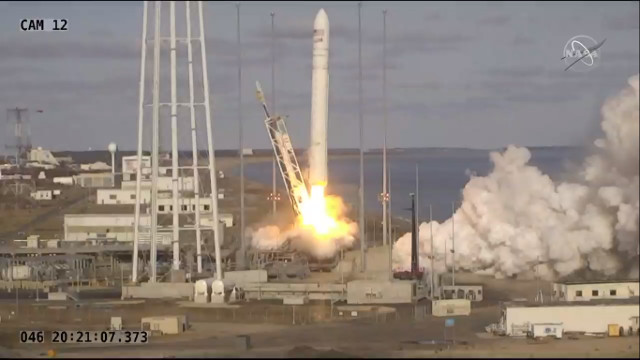
The Cygnus cargo spacecraft blasting off atop an Antares rocket to start its NG-13 mission (Image NASA TV)

A little while ago Northrop Grumman’s Cygnus spacecraft blasted off atop an Antares rocket from the Mid-Atlantic Regional Spaceport (MARS), part of NASA’s Wallops Flight Facility (WFF) on Wallops Island. After about nine minutes it successfully separated from the rocket’s last stage went en route to its destination. This is its 13th official mission, called NG-13 or CRS NG-13, to transport supplies to the International Space Station for NASA.

The Solar Orbiter space probe blasting off atop an Atlas V rocket (Photo ESA - S. Corvaja)

A few hours ago the Solar Orbiter space probe blasted off atop an Atlas V rocket from Cape Canaveral. After about 53 minutes, it successfully separated from the rocket’s last stage and began the long journey that will take it up to about 42 million kilometers from the Sun. A little later it deployed its solar panels and started communicating with the mission control center.

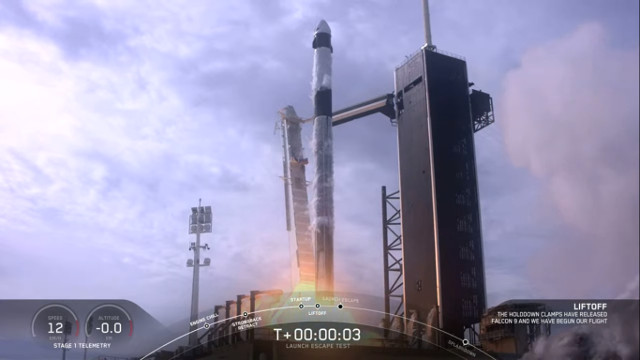
La navicella spaziale Crew Dragon al decollo per il test di interruzione d'emergenza del lancio (Immagine cortesia SpaceX)

SpaceX has just completed the In-Flight Abort Test of one of its Crew Dragon spacecraft, the version of Dragon 2 produced for the transport of astronauts. A Falcon 9 rocket was deliberately blown up at the moment of maximum dynamic pressure, Max q in jargon, to test that the the systems which in a normal launch are used to rescue the crew aboard the Crew Dragon work properly.

Boeing's CST-100 Starliner spacecraft blasting off atop an Atlas V rocket (Image NASA TV)

A little while ago, Boeing’s CST-100 Starliner spacecraft blasted off atop a ULA Atlas V rocket from the Cape Canaveral base in its Boe-OFT (Boeing Orbital Flight Test) mission. After about 15 minutes it successfully separated from the rocket’s last stage. After a little more than half an hour the first of a series of maneuvers for orbit insertion was schduled but a problem emerged that required that the possible options to be assessed to have the CST-100 Starliner go for a proper orbit insertion and on its way to carry out its mission. Boeing has control of the spacecraft, which is in a stable orbit, so it’s not in danger.

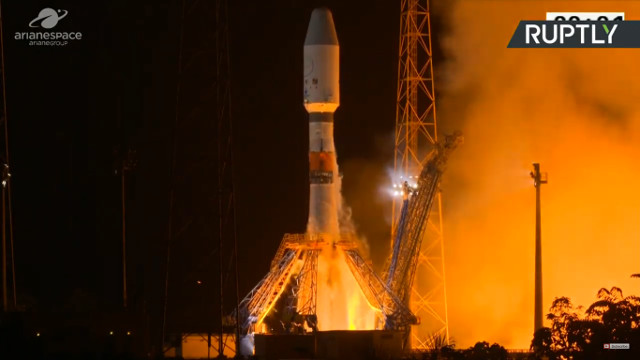
CHEOPS and Cosmo-SkyMed Second Generation blasting off atop aSoyuz rocket (Image courtesy Arianespace)

A few hours ago a Soyuz rocket was launched from the Kourou base, in French Guiana. After about 23 minutes the Cosmo-SkyMed Second Generation satellite successfully separated from the rocket’s Fregat last stage. About 85 minutes after the launch, the CHEOPS space telescope successfully separated from the rocket’s Fregat last stage.

The COSMO-SkyMed Second Generation satellite is the first of a constellation of two satellites that aims to replace the first generation’s four satellites. It’s a system of radar satellites for the territory observation, the result of a collaboration between the Italian Space Agency and the Italian Ministry of Defense.

The purpose of ESA’s CHEOPS (Characterizing ExOPlanets Satellite) space telescope is to conduct follow-up study of exoplanets using the transit method, which means observing the ones that pass in front of their star.