
Launches

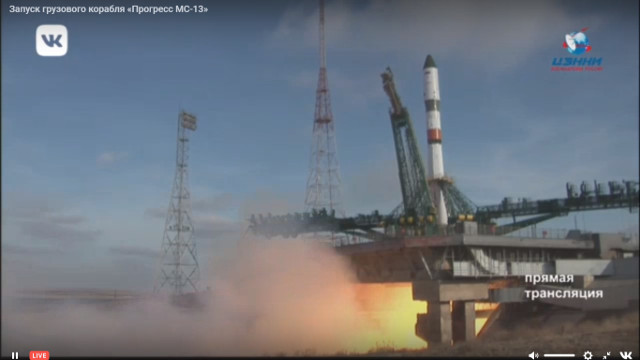
The Progress MS-13 cargo spacecraft blasting off atop a Soyuz-2.1a rocket (Image courtesy Roscosmos)

A little while ago the Progress MS-13 spacecraft blasted off atop a Soyuz-2.1a rocket from the Baikonur Cosmodrome in Kazakhstan. After about nine minutes it successfully separated from the rocket’s last stage and was placed on its route. The cargo spacecraft began its resupply mission to the International Space Station also called Progress 74 or 74P. In this mission, the route used is out of the ordinary since the journey will last about three days.

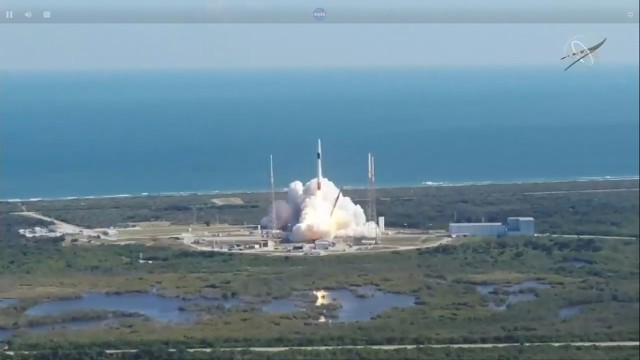
The Dragon cargo spacecraft blasting off atop a Falcon 9 rocket (Image NASA TV)

A little while ago the SpaceX Dragon spacecraft blasted off atop a Falcon 9 rocket from Cape Canaveral in its CRS-19 (Cargo Resupply Service 19) mission, also referred to as SPX-19. After just over ten minutes it separated successfully from the rocket’s last stage and went en route. This is the 19th mission for the Dragon spacecraft to resupply the International Space Station with various cargoes and then return to Earth, again with various cargoes.

60 Starlink satellites blasting off atop a Falcon 9 rocket (Image courtesy SpaceX)

A little while ago 60 satellites of the Starlink constellation were launched on a Falcon 9 rocket from Cape Canaveral. After about an hour they were successfully deployed into their orbit at an altitude of about 280 kilometers all together and then started slowly disperse. This is SpaceX’s second mission to put the Starlink constellation into orbit to provide a global Internet connection coverage.

Northrop Grumman's Cygnus cargo spacecraft blasting off atop an Antares rocket (Image NASA TV)

A little while ago Northrop Grumman’s Cygnus spacecraft blasted off atop an Antares rocket from the Mid-Atlantic Regional Spaceport (MARS), part of NASA’s Wallops Flight Facility (WFF) on Wallops Island. After about nine minutes it successfully separated from the rocket’s last stage went en route to its destination. This is its 12th official mission, called NG-12 or CRS NG-12, to transport supplies to the International Space Station for NASA.

The L-1011 Stargazer aircraft taking off with the ICON satellite (Photo NASA/Frank Michaux)

A few hours ago the ICON (Interface Region Imaging Spectrograph) satellite was launched using a Pegasus XL rocket by Northrop Grumman brought to an altitude of about 11,900 meters by an L-1011 airplane, also by Northrop Grumman, modified for this purpose. After a little more than 11 minutes, ICON was brought into a low Earth orbit at an altitude of about 575 kilometers, where the solar panels regularly deployed and sent the first signals.