Launches

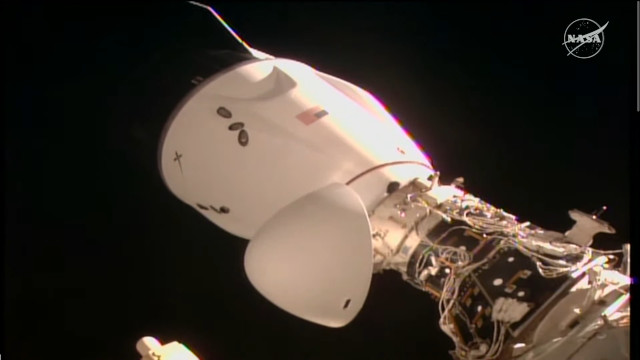
The Crew Dragon Endurance spacecraft docked with the Harmony module of the International Space Station in its Crew-11 mission (Image NASA+)

A little while ago, SpaceX’s Crew Dragon Endurance spacecraft docked with the Harmony module of the International Space Station, completing the first part of its Crew-11 or SpaceX Crew-11 mission that began with its launch about 15.5 hours earlier. After checking that the pressure gets properly balanced, the hatch will be opened to allow Oleg Platonov, Mike Fincke, Kimiya Yui, and Zena Cardman to enter the Station and start their mission, which could last even 8 months.

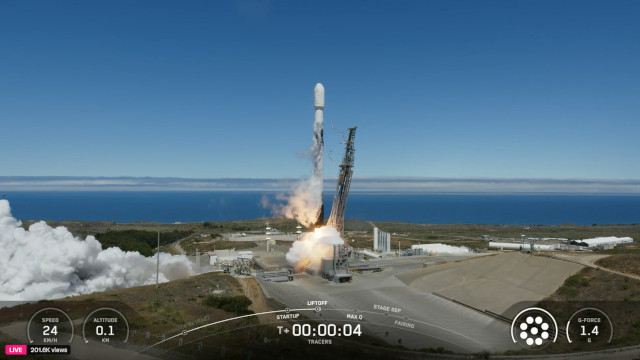
The TRACERS satellites blasting off atop a Falcon 9 rocket (Image SpaceX)

A few hours ago, NASA’s two TRACERS satellites were launched atop a SpaceX Falcon 9 rocket from the Vandenberg Air Force Base. After about an hour and 40 minutes, they successfully separated from the rocket’s last stage to begin the maneuvers that will place them in a Sun-synchronous orbit at an altitude of 600 kilometers.

The two TRACERS (Tandem Reconnection and Cusp Electrodynamics Reconnaissance Satellites) twin satellites join other space missions aimed at studying the Sun and its interactions with the Earth. The PUNCH mission was launched on March 12, and on March 15, the three CubeSat-class nanosatellites of the EZIE (Electrojet Zeeman Imaging Explorer) mission were launched. EZIE’s goal is to study changes in electrical currents moving through the upper layers of Earth’s atmosphere in the polar regions.

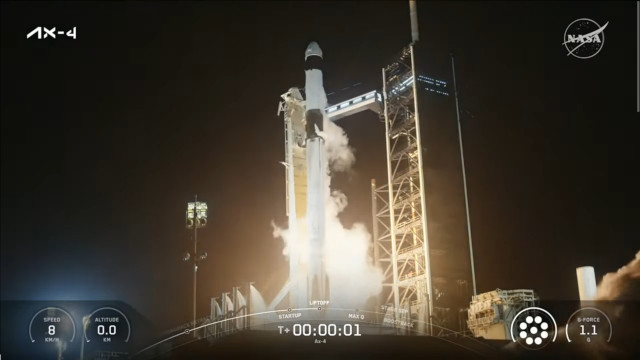
The Crew Dragon Grace spacecraft blasting off atop a Falcon 9 rocket to start its Ax-4 mission (Image NASA)

A little while ago, SpaceX’s Crew Dragon Grace spacecraft was launched atop a Falcon 9 rocket from the Kennedy Space Center on the Axiom Mission 4, or simply Ax-4, mission. After about twelve minutes, it successfully separated from the rocket’s last stage. It will spend up to 14 days in orbit, almost all of which will be docked at the International Space Station. It also serves commercial purposes in a collaboration between SpaceX, Axiom Space, and various companies and national space agencies to access the Station for the purpose of conducting tasks useful for the development of new technologies and for scientific research.

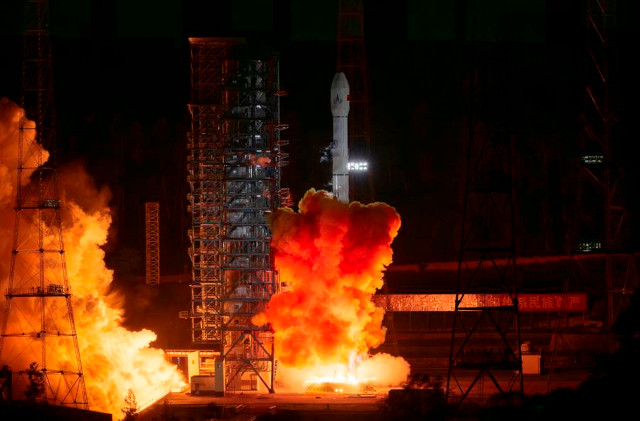
The Tianwen-2 space probe blasting off atop a Long March 3B rocket (Photo courtesy Xinhua/Cai Yang)

A few hours ago, the Tianwen-2 mission was successfully launched. A Long March 3B rocket blasted off from the Xichang Satellite Launch Center, and after about 18 minutes, the space probe separated from the rocket’s last stage to begin its journey towards the asteroid 469219 Kamoʻoalewa. The goal is to collect samples from its surface to bring back to Earth and then resume its journey in space towards the comet 311P/PanSTARRS.

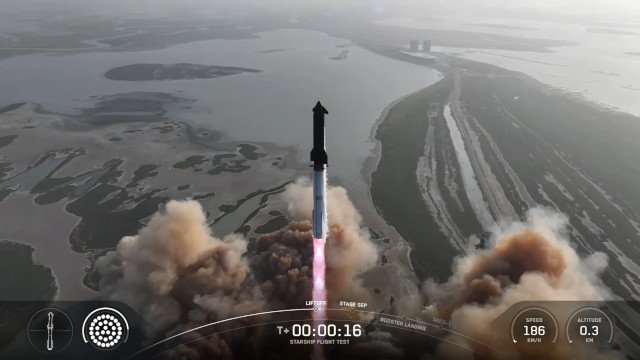
Super Heavy Booster 14 and Starship 35 blasting off (Image courtesy SpaceX)

It was the afternoon in the USA when SpaceX conducted a new flight test of its Super Heavy rocket and Starship prototypes, launched from its base in Boca Chica, Texas. This is the 9th test involving the entire system of Elon Musk’s company, which is supposed to revolutionize space travel with an unprecedented transport capacity and being totally reusable. They are advanced prototypes with the Super Heavy identified as Booster 14, on its second flight in the first reuse of a Super Heavy, and the Starship Block 2 identified as Starship 35 or Ship35 or simply S35.