Stars

The protoplanetary disk AS 209 (Image ALMA (ESO/NAOJ/NRAO)/ D. Fedele et al.)

An article published in the journal “Astronomy & Astrophysics” describes the study of the protoplanetary disk AS 209. A team of researchers led by Davide Fedele of INAF Arcetri, Italy, used the ALMA radio telescope to observe that disk of gas and dust around a star in its formation phase showing a central core and two large rings with two large gaps. Their conclusion is that there’s at least one planet with a mass that could be close to Saturn’s orbiting at a considerable distance from its star.

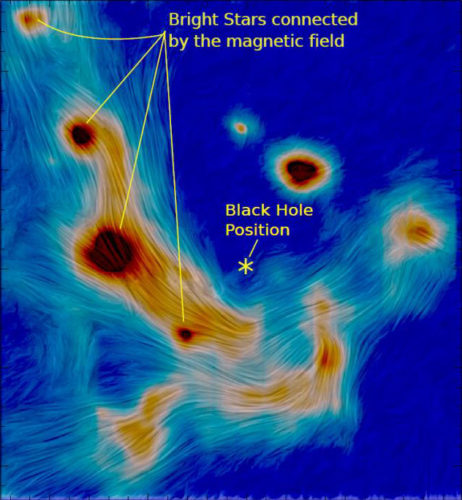
The magnetic field at the center of the Milky Way (Image E. Lopez-Rodriguez / NASA Ames / University of Texas at San Antonio)

An article published in the journal “Monthly Notices of the Royal Astronomical Society” describes the detailed mapping of the magnetic field around Sagittarius A*, also known simply as Sgr A*, the supermassive black hole at the center of the Milky Way. A team of researchers used the CanariCam infrared camera installed on the Grand Telescopio Canarias to obtain the data needed to reproduce the magnetic lines of gas and dust that orbit around the center of the galaxy. The structure of the magnetic lines gives the result a style that reminds of Vincent Van Gogh’s paintings.

The hypernova DES16C2nm in the circle (Image M. Smith / DES Collaboration)

An article published in “The Astrophysical Journal” describes the confirmation that the supernova DES16C2nm is the most distant ever discovered. A team of astronomers led by the University of Southampton used data collected by the Dark Energy Survey (DES) and various telescopes to study it and classify it as a superluminous supernova (SLSN) or hypernova, the brightest and most rare type of supernova. The distance of the exploded star has been estimated at about 10.5 billion light years from Earth.

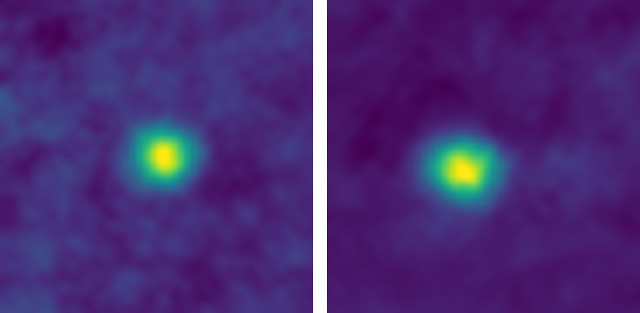
False-color photo of 2012 HZ84 and 2012 HE85 (Image NASA/JHUAPL/SwRI)

NASA has published some photos taken by its New Horizons space probe’s LORRI instrument in December 2017. During the course of its journey that will lead to the object called 2014 MU69’s flyby, New Horizons took photos that beat the record that belonged to Voyager 1 for the farthest photo ever taken from Earth capturing images of the open stellar cluster called Wishing Well and two Kuiper Belt Objects called 2012 HZ84 and 2012 HE85.

Artist's concept of TRAPPIST-1's planets with the Earth (Image ESO/M. Kornmesser)

Two articles, one published in the journal “Astronomy & Astrophysics” and one in the journal “Nature Astronomy”, describe two researches on the TRAPPIST-1 system’s rocky planets. Various telescopes, both space and ground-based, allowed to gather more information on those 7 exoplanets and to improve the measurements of their characteristics. An important result is the estimate of their density, which suggests that some of them are composed up to 5% of water. Spectroscopic detections suggest that at least 3 of them have a compact atmosphere that could allow liquid water to exist on their surface.