Stars

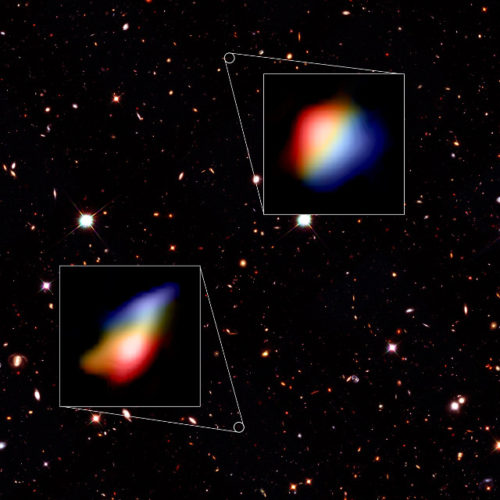
The early galaxies observed by ALMA in the sky observed by Hubble (Image Hubble (NASA/ESA), ALMA (ESO/NAOJ/NRAO), P. Oesch (University of Geneva) and R. Smit (University of Cambridge))

An article published in the journal “Nature” describes the first observation of the movement of gas inside two small newborn galaxies about 13 billion light years away from Earth. A team led by the Dutch astronomer Renske Smit of the Kavli Institute of Cosmology at the University of Cambridge, UK, used the ALMA radio telescope to detect the processes underway in those early galaxies, verifying that the gas moves similarly to galaxies such as Milky Way. These results were also presented at the 231st meeting of the American Astronomical Society, which was held this week.

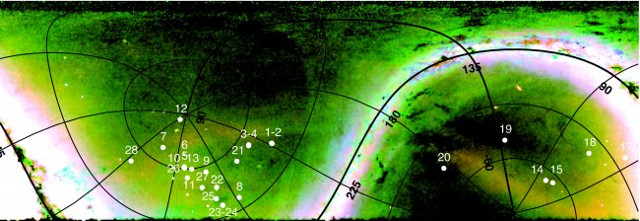
The Milky Way's halo in the Pan-Starrs1 map (Image courtesy Giuseppina Battaglia (Iac))

An article published in the journal “Astronomy & Astrophysics” describes a research on a group of red giant stars located in the halo surrounding the Milky Way. A team of astronomers led by Giuseppina Battaglia of the Istituto de Astrofísica de Canarias examined the composition of a 28-star sample discovering that the presence of some chemical elements is quite different from the halo’s innermost regions. The conclusion is that they were not born in our galaxy but in ancient dwarf galaxies that were absorbed by the Milky Way.

The Tarantula Nebula (Image X-ray: NASA/CXC/PSU/L.Townsley et al.; Optical: NASA/STScI; Infrared: NASA/JPL/PSU/L.Townsley et al.)

An article published in the journal “Science” describes the really out-of-the-ordinary amount of massive stars discovered in the Tarantula Nebula, a region of the Great Magellanic Cloud, one of the Milky Way’s satellite dwarfs galaxies. A team of researchers participating in the VLT-FLAMES Tarantula Survey (VFTS) used ESO’s Very Large Telescope to observe nearly 1,000 massive stars in that region concluding that there’s a much higher amount than expected by the models with various important astronomical implications.

KIC 8462852 at infrareds and ultraviolets (Image: IPAC/NASA for infrareds, STScI (NASA) for ultraviolets)

An article published in “The Astrophysical Journal Letters” describes the results of new observations of the star KIC 8462852, commonly known as Tabby’s star or sometimes Boyajian’s star. A team of astronomers led by Tabetha S. Boyajian, the astronomer who in 2015 realized that its brightness was changing rapidly, dimming up to 20% within a few days, conducted a research possible thanks to a funding obtained through a campaign on Kickstarter. The conclusions confirm the theory of dust that obscures the star, in particular at certain frequencies.