Stars

Scenarios after the kilonova (Image NRAO/AUI/NSF: D. Berry)

An article published in the journal “Nature” describes a research on the consequences of the merger between two neutron stars observed in the emission of both electromagnetic and gravitational waves. A team of researchers led by Kunal Mooley of the US National Radio Astronomy Observatory (NRAO) used the Very Large Array (VLA) together with the Australia Telescope Compact Array and the Giant Metrewave Radio Telescope in India for three months from the beginning of September to detect the radio waves emitted by the event at the origin of the gravitational waves recorded on August 17, 2017 in the event labeled as GW170817.

Comparison between the Kepler-90 system and the solar system (Image NASA/Ames Research Center/Wendy Stenzel)

At a press conference, the annoucement came of the first exoplanets discovered thanks to the TensorFlow machine learning engine created by Google. Researchers Christopher Shallue and Andrew Vanderburg trained this system to make it recognize exoplanets in the data collected by NASA’s Kepler space telescope. The two exoplanets announced are Kepler-90i and Kepler-80g but it’s only the beginning for a new way to look for exoplanets, especially the smaller ones that leave very weak traces.

Artist's concept of part of the planet K2-18b with a thick atmosphere, its star and the planet K2-18c in the background (Image courtesy Alex Boersma)

An article published in the journal “Astronomy & Astrophysics” describes a research on the star K2-18’s system. A team of researchers used the HARPS instrument at ESO’s La Silla observatory in Chile to study the exoplanet K2-18b, discovered in 2015, which could be a larger version of the Earth. The analysis of the data led to the discovery of a second exoplanet, which was called K2-18c, a little less massive and closer to its star therefore probably too hot to be in ​​its system’s habitable zone.

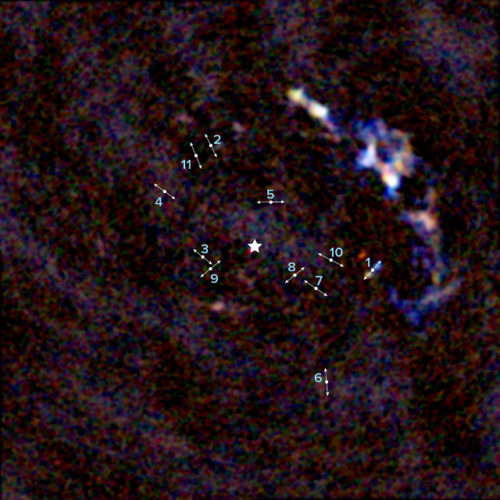
The protostars detected by ALMA (Image ALMA (ESO/NAOJ/NRAO), Yusef-Zadeh et al.; B. Saxton (NRAO/AUI/NSF))

An article published in the “Astrophysical Journal Letters” describes the discovery of protostars near the center of the Milky Way, near the supermassive black hole known as Sagittarius A* (or Sgr A*). A team of astronomers made this discovery using the ALMA radio telescope, a surprising result because the conditions in that area were considered too hostile due to the gravitational tides caused by Sgr A* and the intense electromagnetic emissions from the heated gas and dust ring around it.

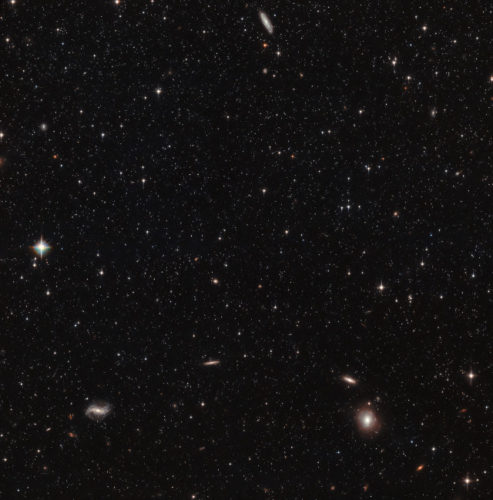
A part of the Sculptor Dwarf Galaxy (Image ESA/Hubble & NASA)

An article published in the journal “Nature Astronomy” reports the reconstruction of the 3D movements of 10 stars in the Sculptor Dwarf Galaxy selected within a larger sample of over 100 among those with the smallest measurement errors. A team of researchers used observations made using the Hubble Space Telescope in 2002 and subsequent observations carried out by ESA’s Gaia space probe between 2014 and 2015 to produce this reconstruction that confirms the “cold” dark matter model.