Stars

An article published in the journal “Monthly Notices of the Royal Astronomical Society” describes a research that revealed a surprise in the origin of electromagnetic radiation from the Crab Nebula that can influence the research on cosmic rays. Federico Fraschetti of the University of Arizona, USA, and Martin Pohl of the University of Potsdam, Germany, believe that the model created by Enrico Fermi in 1949 is to be partially revised because those radiation are produced in a way different from what was thought.

Cosmic Eyelash seen by ALMA (Image ALMA (ESO/NAOJ/NRAO)/E. Falgarone et al.)

An article published in the journal “Nature” describes the first detection in the distant universe of the carbon hydride molecule, or CH+. A team led by Edith Falgarone of the Ecole Normale Supérieure and Observatoire de Paris, France, used the ALMA radio telescope to discover that cold and turbulent gas in galaxies of the starburst type such as SMM J2135-0102, nicknamed Cosmic Eyelash. This discovery will help to better understand the mechanisms of galaxy growth and the periods of rapid star formation.

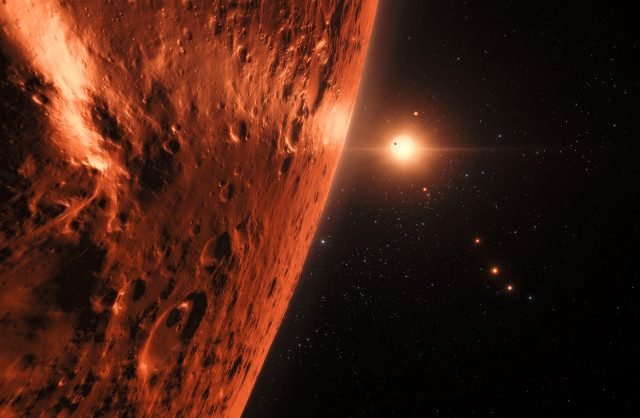
Artist's impressione of the TRAPPIST-1 system seen from one of its planets (Image ESO/N. Bartmann/spaceengine.org)

An article published in “The Astronomical Journal” describes a research in which an estimate of the presence of water on the seven planets of the star system TRAPPIST-1 is provided. A team of astronomers led by Vincent Bourrier of the Observatoire de l’Université de Genève, Switzerland, used the Hubble Space Telescope to examine that system concluding that its outer planets are more likely tyo still have a substantial amount of water. They include the three planets in the system’s habitable zone.

The Pleiades seen by the Kepler Space Telescope (Image NASA / Aarhus University / T. White)

An article published in the journal “Monthly Notices of the Royal Astronomical Society” describes the most detailed study ever made on the variability of the Pleiades. A team of astronomers led by Dr. Tim White of the Stellar Astrophysics Center at the Danish University of Aarhus used a new algorithm to improve the observations made by NASA’s Kepler Space Telescope in its K2 mission.