Stars

Artist's concept of the orbits of 3 stars near the supermassive black hole at the center of the Milky Way (Image ESO/M. Parsa/L. Calçada)

An article published in “The Astrophysical Journal” describes an analysis of the motions of stars that orbit the supermassive black hole at the center of the Milky Way, particularly the one known as S2. A team of astronomers applied a new analytical technique to observations conducted in the past with ESO’s Very Large Telescope (VLT) in Chile and other telescopes concluding that those orbits are influenced by the effects of Albert Einstein’s theory of general relativity.

An article published in the journal “Astronomy & Astrophysics” describes a research involving 16 of the brightest known quasars. A team of researchers led by the Italian National Institute of Astrophysics (INAF) examined in particular those quasars’ infrared emissions to identify young hot stars in the galaxies hosting them concluding that a lot of them are forming, at a rate up to about 4,000 times higher than in the Milky Way.

Artist's concept of the dusty starburst galaxy WISE J224607.57-052635.0 (Image NASA/JPL-Caltech)

An article published in “The Astrophysical Journal” describes a research suggesting that in primeval galaxies of the type called dusty starburst – because dust filters their light – star formation activity can be inhibited by the presence of a quasar. A team of astronomers from Iowa University used the ALMA radio telescope to locate the quasars and then other telescopes to observe them at various wavelengths.

Artist's concept of a gas giant planet with a habitable exomoon (Image courtesy Andy McLatchie)

An article sent to arXiv, the famous archive of preprint, describes the discovery of an exomoon candidate. A team of researchers led by David Kipping of Columbia University conducted a search for moons orbiting exoplanets observed by NASA’s Kepler Space Telescope finding the candidate called Kepler-1625b I. Generally, research results are published on a scientific journal at the end of the work but rumors spread convincing the researchers to send an article at least to arXiv.

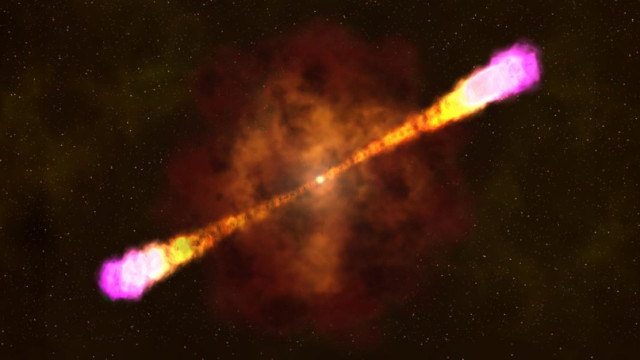
Artist's illustration of a gamma-ray burst (Image NASA’s Goddard Space Flight Center)

An article published in the journal “Nature” describes the observation of a gamma-ray burst named GRB 160625B. An international team of astronomers led by Eleonora Troja of the University of Maryland used a number of telescopes after its discovery with NASA’s Fermi space telescope to detect the properties of this extremely energetic event, its geometry, the orientation of its jets and the origin of its extremely bright optical flash.