Stars

A pair of stars in their dense core within the Perseus cloud (Image courtesy SCUBA-2 survey image by Sarah Sadavoy, CfA)

An article published in the journal “Monthly Notices of the Royal Astronomical Society” describes a study on the diffusion of binary systems composed of low-mass stars. The astronomers Sarah Sadavoy of the Smithsonian Astrophysical Observatory and Steven Stahler of the University of Berkeley studied very young stars in the molecular cloud of the constellation of Perseus concluding that that kind of stars is always born in pairs, including the Sun.

Orion KL Source I seen by ALMA (Image ALMA (ESO/NAOJ/NRAO), Hirota et al.)

An article published in the journal “Nature Astronomy” describes a study of the massive newborn baby star Orion KL Source I. A team of astronomers led by Tomoya Hirota used the ALMA radio telescope to capture what was called the birth cry of that star and determine that its outflow’s motion and shape indicate that the interaction of centrifugal and magnetic forces in a disk surrounding the star plays a crucial role in that cry.

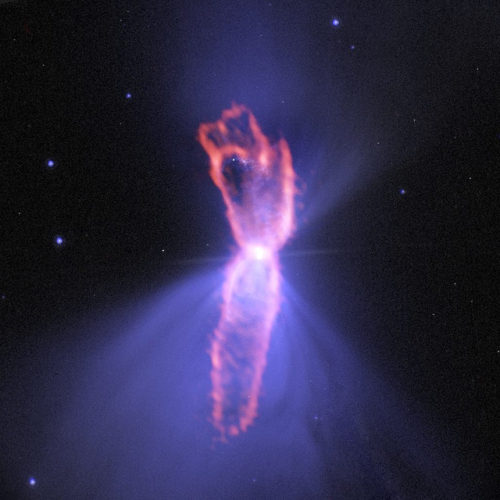
The Boomerang Nebula seen by ALMA and Hubble (Image ALMA (ESO/NAOJ/NRAO); NASA/ESA Hubble; NRAO/AUI/NSF)

An article published in “The Astrophysical Journal” describes a research about the Boomerang Nebula, described as the coldest spot in the universe. A team led by Raghvendra Sahai of NASA’s Jet Propulsion Laboratory used the ALMA radio telescope to understand why the outflow of materials from the star at the center of the nebula is expanding very quickly. According to the astronomers there’s a companion and the gravitational interactions between the two stars accelerated that outflow.

Artist's concept of the star KELT-9 and the planet KELT-9b (Image NASA/JPL-Caltech)

An article published in the journal “Nature” describes the study of the planet KELT-9b. This is an extreme case of hot Jupiter, a gas giant planet like Jupiter so close to its star to be considerably heated up. KELT-9b has an estimated surface temperature in the area exposed to its star that can exceed 4,600 Kelvin, so much that its atmosphere is likely to be dissipating in space and may have a tail similar to that of comets.

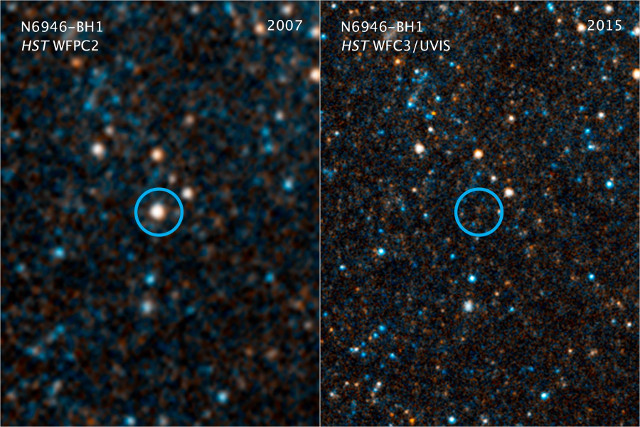
The area where the star N6946-BH1 used to be before and after its disappearance (Image NASA/ESA/C. Kochanek (OSU))

An article published in the journal “Monthly Notices of the Royal Astronomical Society” describes the discovery of a massive star called N6946-BH1 that collapsed and seems to have formed a black hole directly without exploding into a supernova. A team of astronomers led by Christopher Kochanek used the Large Binocular Telescope (LBT) in Arizona and NASA’s Hubble and Spitzer space telescopes to observe for the first time this phenomenon, which could explain why there are less supernovae than expected.