Stars

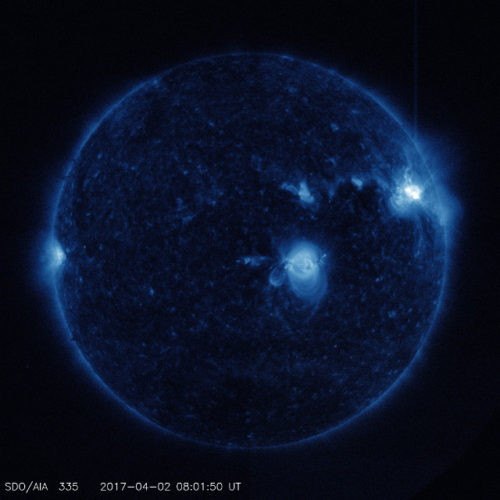
The Sun right before the first flare's peak (Photo NASA/SDO)

In recent days, NASA’s SDO (Solar Dynamics Obersavatory) space probe detected and documented 3 M-class solar flares, the class that includes the most powerful ones after the X-class, where X means “eXtreme”. The first one had its peak on April 2 at 8.02 UTC, the second one at 20.33 UTC and the third one on April 3 at 14:29 UTC.

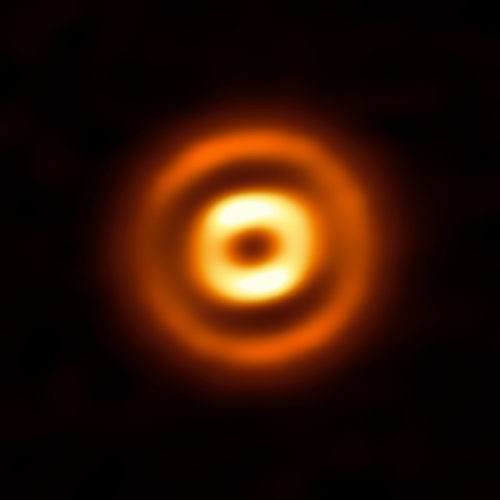
The HD 169142 system (Image ALMA (ESO/NAOJ/NRAO)/ Fedele et al.)

An article published in the journal “Astronomy & Astrophysics” describes the discovery of traces of two planets that are forming in the young system HD 169142. A team of researchers led by Davide Fedele of the Institute of Astrophysics in Florence, Italy, used the ALMA radio telescope to study the of gas and dust disk surrounding the young star identifying gap rings compatible with the formation of planets similar to Jupiter.

The runaway stars and their positions (Image NASA, ESA, K. Luhman (Penn State University), and M. Robberto (STScI))

An article published in “The Astrophysical Journal Letters” describes a research about what used to be a multiple system in the Orion Nebula. A team of researchers led by Kevin Luhman of Penn State University used the Hubble Space Telescope to discover a runaway star that was part of the original system with two other stars already known that are also traveling at high speeds. The three stars were part of a single system untile about 540 years ago.

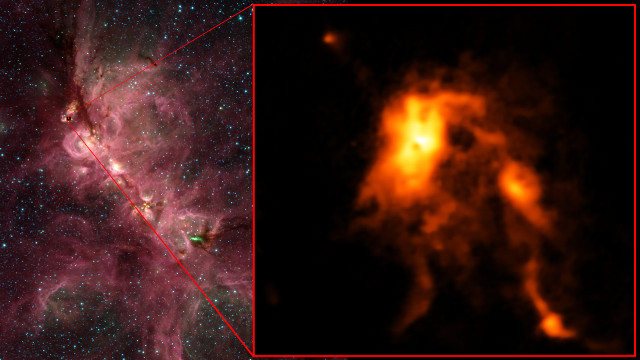
The Cat's Paw Nebula and the protostar NGC 6334I-MM1 (Image ALMA (ESO/NAOJ/NRAO), T. Hunter; C. Brogan, B. Saxton (NRAO/AUI/NSF); GLIMPSE, NASA/JPL-Caltech)

An article published in “Astrophysical Journal Letters” describes the study of a protostar indicated as NGC 6334I-MM1 which increased its brightness 100 times. A team led by astronomer Todd Hunter of the National Radio Astronomy Observatory (NRAO) discovered this transformation by comparing new observations carried out with the ALMA radio telescope with other ones previously carried out with the SMA radio telescope.

Artist's impression of the X9 system with the view from Chandra X-ray Observatory in the inset (Image X-ray: NASA/CXC/University of Alberta/A.Bahramian et al.; Illustration: NASA/CXC/M.Weiss)

An article published in the journal “Monthly Notices of the Royal Astronomical Society” describes a research on what appears to be a binary system including a star with the closest orbit around a black hole. A team of astronomers used NASA’s Chandra X-ray Observatory and NuSTAR space Telescope and the Australia Telescope Compact Array (ATCA) to observe this system called X9 concluding that the star, a white dwarf, takes 28 minutes to orbit the black hole.