Stars

The N79 South molecular complex (Image ESA/Webb, NASA & CSA, O. Nayak, M. Meixner)

An image captured by the James Webb Space Telescope shows a part of the star-forming region cataloged as N79 in the Large Magellanic Cloud, one of the Milky Way’s satellite dwarf galaxies. It’s considered a sort of younger version of the Tarantula Nebula but astronomers believe that its star formation has been twice as efficient over the last 500,000 years. The Mid-InfraRed Instrument (MIRI) was used to capture never-before-seen mid-infrared details of N79 that will be invaluable in improving our understanding of star formation processes.

Artist's impression of the compact object in the black hole mass gap with the NGC 1851E pulsar at the top (Image courtesy Daniëlle Futselaar (artsource.nl))

An article published in the journal “Science” reports the discovery of a compact object within the globular cluster cataloged as NGC 1851 whose nature is uncertain because mass estimates place it on the border between a neutron star and a black hole. A team of researchers used observations conducted with the MeerKAT radio telescope to identify traces of a binary system composed of a so-called millisecond pulsar and the mysterious compact object. The estimated mass for this object is between 2.09 and 2.71 times the Sun’s, so it could be a massive neutron star or a small black hole.

Illustration of the HD 63433 star system

An article published in “The Astronomical Journal” reports confirmation of the existence of the exoplanet HD 63433d, a rocky planet with a size close to the Earth’s that orbits a star very similar to the Sun in a system that was already known. A team of researchers led by Melinda Soares-Furtado of the University of Wisconsin-Madison and Benjamin Capistrant, now a student at the University of Florida, used data collected by NASA’s TESS space telescope to identify HD 63433d within the THYME (TESS Hunt for Young and Maturing Exoplanets) survey. Its close proximity to its star probably makes it a so-called lava planet since on the dayside, the temperature on its surface is estimated at over 1,500° Kelvin.

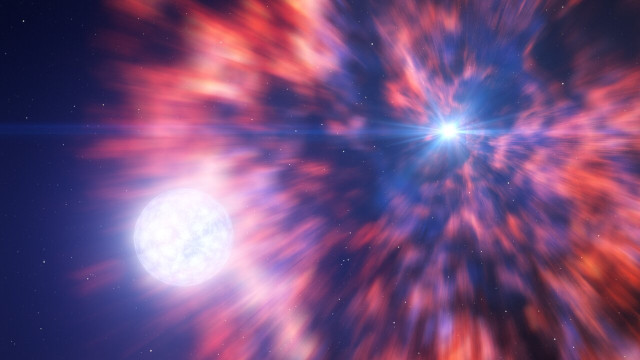
Artist's concept of the aftermath of a supernova in a binary system (Image ESO/L. Calçada)

Two articles, one published in the journal “Nature” and one in “The Astrophysical Journal Letters”, report different aspects of a study of the supernova remnant cataloged as SN 2022jli which include evidence of the presence of a compact object that could be a neutron star or a black hole that formed after the supernova. Two teams of researchers used various instruments including the Very Large Telescope (VLT) and the New Technology Telescope (NTT), both ESO’s, to study the consequences of this supernova and find the direct link to the formation of a compact object.

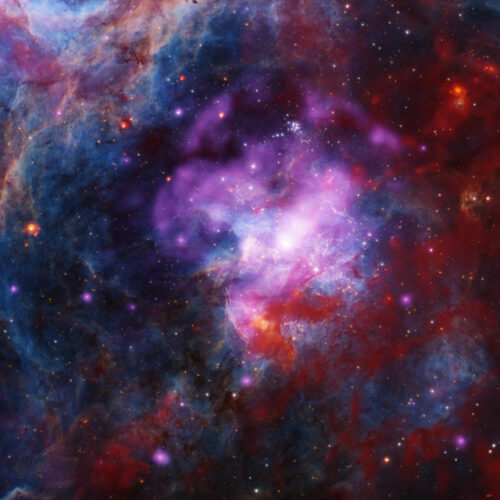
30 Doradus B (Image X-ray: NASA/CXC/Penn State Univ./L. Townsley et al.; Optical: NASA/STScI/HST; Infrared: NASA/JPL/CalTech/SST; Image Processing: NASA/CXC/SAO/J. Schmidt, N. Wolk, K. Arcand)

An article published in “The Astronomical Journal” reports evidence that the supernova remnant cataloged as 30 Doradus B, or simply 30 Dor B, is the result of at least two separate supernovae and not just one. A team of researchers led by Wei-An Chen of the National Taiwan University combined observations conducted with various telescopes in different electromagnetic bands to find evidence of a vast but very faint shell spanning 130 light-years that adds to the remnant visible at optical frequencies. At the same time, a wind was detected that generates a nebula of the type called pulsar wind nebula. That remnant can’t have been generated by a single supernova.