Stars

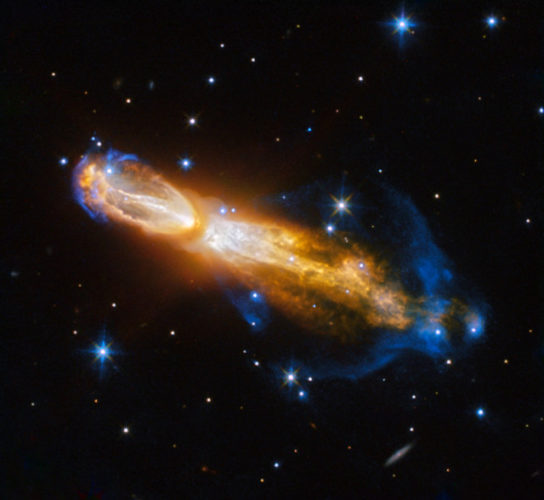
The Calabash Nebula (Image ESA/Hubble & NASA. Acknowledgement: Judy Schmidt)

A photograph taken by the Hubble Space Telescope shows the Calabash Nebula, a protoplanetary nebula showing the agony of a low-mass star like the Sun. This nebula is also known by the nickname Rotten Egg Nebula because its study revealed that in the gas surrounding it there’s a high concentration of sulfur, the element that causes the characteristic rotten egg smell.

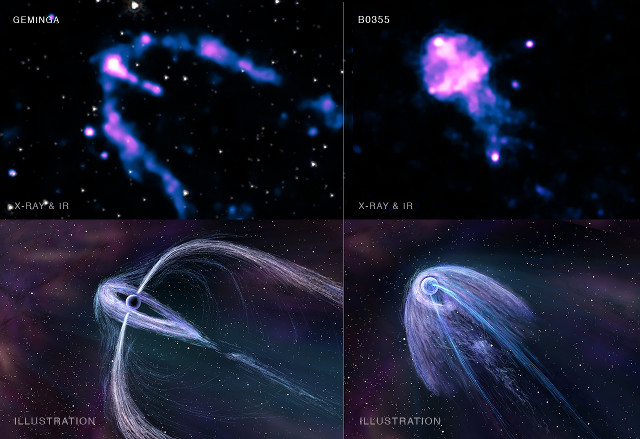
The pulsars Geminga and PSR B0355+54 with the illustration of their plerions (Image X-ray: NASA/CXC/PSU/B.Posselt et al; Infrared: NASA/JPL-Caltech; Illustration: Nahks TrEhnl)

Two articles published in “The Astrophysical Journal” describing research on as many pulsar that allow to better understand the geometry of the plasma in their vicinity. Two independent team used NASA’s Chandra space telescope to study the pulsar Geminga, also known as PSR B0633+17, and PSR B0355+54 gathering information on the nebulas of high-energy particles called in jargon plerions generated by the pulsars.

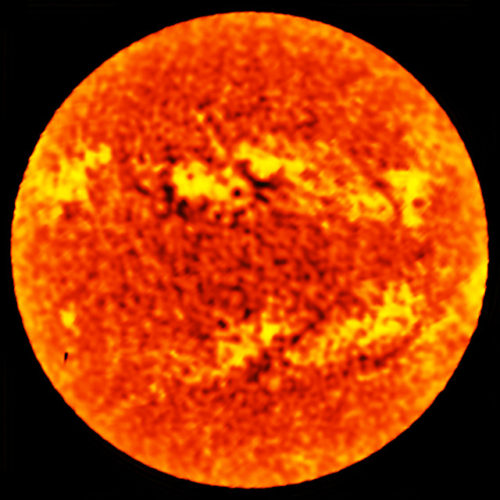
The solar disc seen by ALMA (Image ALMA (ESO/NAOJ/NRAO))

The first images of the Sun generated by observations carried out using the ALMA radio telescope have been published. This is the first time that the largest radio telescope in the world has been used in this way and this is the beginning of an important expansion in ALMA’s use. The first results are details of the Sun’s chromosphere such as a sunspot twice the size of Earth.

Elements of life

At the 229th Meeting of the American Astronomical Society held recently, astronomers of the SDSS/APOGEE project announced the results of a study that included more than 150,000 stars in the Milky Way. Each star was analyzed to determine the amount of nearly two dozen chemical elements, including carbon, hydrogen, nitrogen, oxygen, phosphorus and sulfur, the ones that form life’s building blocks.

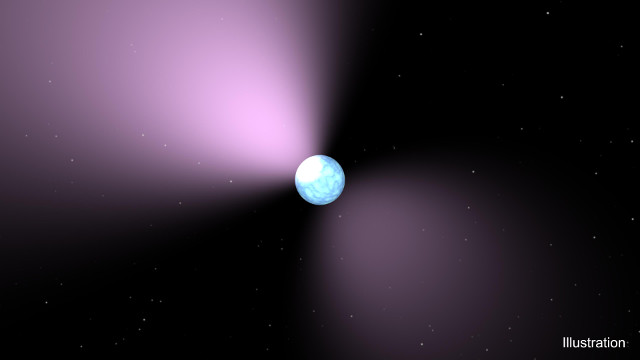
Artist's concept of a neutron star (Image NASA/JPL-Caltech)

An article published in “Astrophysical Journal Letters” describes a research, also presented recently at the meeting of the American Astronomical Society, about the pulsar known as PSR J1119-6127. Discovered over 16 years ago, recently it showed behaviors typical of a magnetar, a different type of neutron star. This oddity might help explain the link between pulsars and magnetars and the evolution of neutron stars.