Stars

Area around the Milky Way's center (Image courtesy Alex Mellinger)

An article published in the journal “Monthly Notices of the Royal Astronomical Society” describes the discovery of a new family of stars at the center of the Milky Way tha are unusually nitrogen-rich. A team of astronomers from the Liverpool John Moores University (LJMU) made this discovery working on the APOGEE (the Apache Point Observatory Galactic Evolution Experiment) project, which aims to collect infrared data of hundreds of thousands of stars in the Milky Way.

Cygnus X-3 and little friend (Image X-ray: NASA/CXC/SAO/M.McCollough et al, Radio: ASIAA/SAO/SMA)

An article published in “The Astrophysical Journal Letters” describes a research on Cygnus X-3, a binary system consisting of a massive star slowly consumed by its companion, a black hole or a neutron star that is gas continuously taking gas away from it. A team of researchers used NASA’s Chandra X-ray Observatory and the Smithsonian’s Submillimeter Array (SMA) to detect the emissions generated from Cygnus X-3, reflected by a star-forming cloud.

Illustration of OGLE-2015-BLG-1319: in grey the data from ground-based telescopes, in blue the data from Swift and in red the data from Spitzer (Image NASA/JPL-Caltech)

An article published in “Astrophysical Journal” describes the study of a brown dwarf that orbits a K-type star that was possible thanks to a gravitational microlensing event. An international team of astronomers used NASA’s Swift and Spitzer space telescopes to take advantage of that event, cataloged as OGLE-2015-BLG-1319, at a distance from its star that at which few of those objects were found, hence the name brown dwarf desert.

The RX J1615 system (Image ESO, J. de Boer et al.)

Three articles accepted for publication in the journal “Astronomy and Astrophysics” describe as many research on star systems in formation. The research were conducted by different teams of astronomers but have in common the use of the SPHERE instrument mounted on ESO’s VLT (Very Large Telescope), which revealed details never seen before of protoplanetary discs around the young stars RX J1615, HD 97048 and HD 135344B.

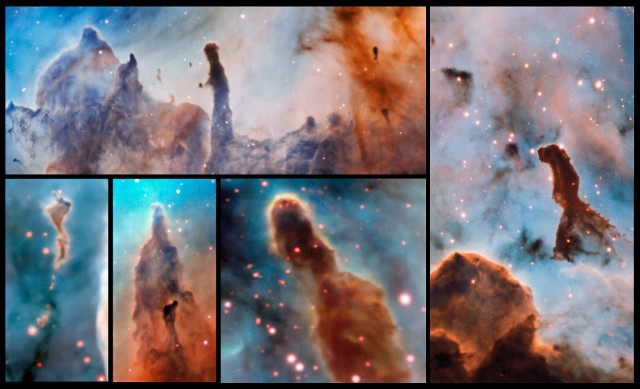
Pillars within the Carina Nebula (Image ESO/A. McLeod)

An article accepted for publication in the journal “Monthly Notices of the Royal Astronomical Society” describes a research on the large columnar structures in the Carina Nebula. A team led by Anna McLeod, a PhD student at ESO, used the MUSE instrument installed on ESO’s VLT (Very Large Telescope) to examine these structures that have been nicknamed “pillars of destruction” for certain similarities with the “Pillars of Creation” photographed by the Hubble space telescope.