Stars

DEM L316A seen by the Hubble Space Telescope (Image ESA/Hubble & NASA, Y. Chu)

A photograph taken by the Hubble Space Telescope shows the remains of a star that died long ago. Those are wisps of ionized gas that still emit a faint glow, the last product of the immense energy generated in a Type Ia supernova. These supernova remnants called DEM L316A are located in the Large Magellanic Cloud, a satellite galaxy of the Milky Way, about 160,000 light-years away from Earth.

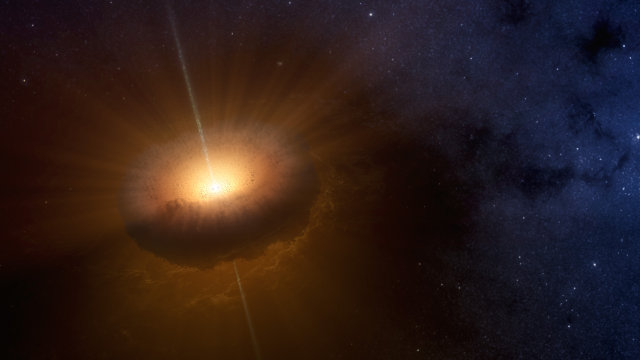
Artistic representation of the star CX330 and the disk of gas and dust surrounding it (Image NASA/JPL-Caltech)

An article published in the journal “Monthly Notices of the Royal Astronomical Society” describes a research of an object called CX330 which for some years has been mysterious and was later found to be a young star. A group of researchers led by Chris Britt of Texas Tech University used data collected from NASA’s Chandra and WISE space telescopes and others to determine its nature. It remains unclear why CX330 is so isolated.

Artistic concept of two exoplanets transiting in front of the TRAPPIST-1 star (Image NASA/ESA/STScI/J. de Wit (MIT))

An article published in the journal “Nature” describes a research on two exoplanets of the TRAPPIST-1 system. A group of researchers led by Julien de Wit of the Massachusetts Institute of Technology in Cambridge, Massachusetts used the Hubble and Spitzer space telescopes to better examine two of the three exoplanets whose discovery was announced in May 2016.

Artistic concept of the V883 Orionis system with its protoplanetary disc and the snow in it (Image A. Angelich (NRAO/AUI/NSF)/ALMA (ESO/NAOJ/NRAO))

An article published in the journal “Nature” describes the first observation ever of the water snow line in the V883 Orionis system. Using the ALMA radio telescope, a team led by Lucas Cieza of the Universidad Diego Portales, Santiago, Chile, identified the distance from the star beyond which the temperature drops enough for water to freeze.

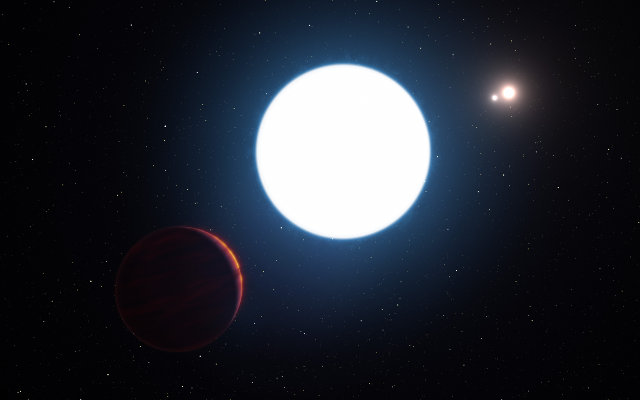
Artistic representation of the HD 131399 system with its exoplanet and its three stars (Image ESO/L. Calçada)

An article published in the journal “Science” describes the discovery of the exoplanet HD 131399Ab, the first ever found in a system with three suns. A team of astronomers led by the University of Arizona used the SPHERE instrument mounted on ESO’s VLT to obtain a direct image of HD 131399Ab and its system’s three stars. Scientists thought that such an orbit was unstable but this case seems to contradict that idea.