Stars

Artistic representation of the TRAPPIST-1 system with its planets seen from one of them (Image ESO/M. Kornmesser)

An article published in the journal “Nature” describes the discovery of a solar system with three rocky planets that orbit the star TRAPPIST-1, a really small ultra-cool dwarf. A team led by Michaël Gillon of the Institut d’Astrophysique et Géophysique at the University of Liège in Belgium, found these planets with sizes and surface temperatures similar to those of the Earth using the TRAPPIST telescope at ESO’s La Silla Observatory in Chile.

A comparison between the Sun, a low mass star, a brown dwarf, Jupiter and the Earth (Image NASA/JPL-Caltech/UCB)

An article published in the journal “Astronomy & Astrophysics” describes a study of the brown dwarfs that should be present in the cosmic neighborhood. A team of astronomers from the Leibniz-Institut für Astrophysik Potsdam (AIP), Germany, re-analyzed data from observations and cataloging of the brown dwarfs less than six and a half parsecs from Earth and concluded that there should be more of them and maybe we haven’t found them yet.

The Andromeda galaxy with the pulsar's signal in the inset (Image Andromeda: ESA/Herschel/PACS/SPIRE/J. Fritz, U. Gent/XMM-Newton/EPIC/W. Pietsch, MPE; data: P. Esposito et al (2016))

An article published in the journal “Monthly Notices of the Royal Astronomical Society” describes the discovery of the first pulsar in the Andromeda galaxy. A team led by Paolo Esposito of INAF-Istituto di Astrofisica Spaziale e Fisica Cosmica, Milan, Italy, found this elusive object using the archives of observations made with ESA’s XMM-Newton space telescope.

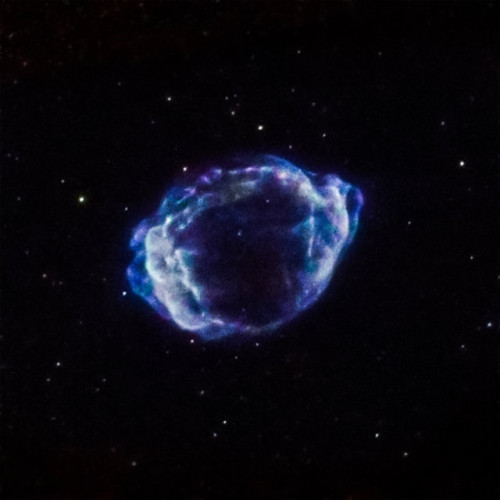
The supernova G1.9+0.3 (Image NASA/CXC/CfA/S. Chakraborti et al.)

An article published in “Astrophysical Journal” describes the analysis of the supernova remnant G1.9+0.3, the youngest observed in the Milky Way. A team of astronomers from Harvard University used data collected by NASA’s Chandra space telescope and the VLA radio telescope to find evidence that it’s an explosion triggered by the merger of two white dwarfs, what is called a Type Ia supernova.