
Stars

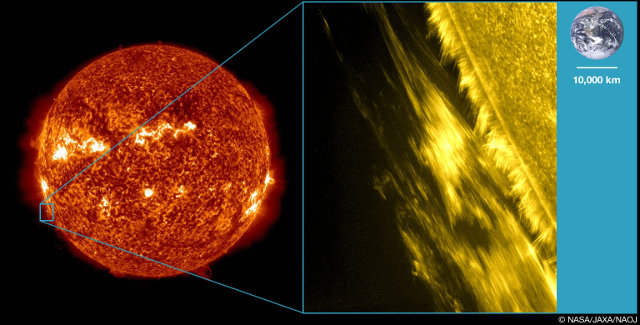
On the left a picture of the Sun taken by the SDO space probe, at the center a close-up of a prominence and on the right a picture of the Earth in the same scale (Image NASA/JAXA/NAOJ)

Two articles published in “The Astrophysical Journal” describe a study of what is known as the coronal heating problem. For decades, scientists have been trying to understand why the temperature on the surface of the Sun is about 6,000 Kelvin while the corona, the region between the surface and the area of ​​the outer atmosphere, can reach temperatures of several million degrees. Now a team of researchers led by Takenori Okamoto of the Solar-Terrestrial Environment Laboratory at Nagoya University and ISAS/JAXA and Patrick Antolin of the National Astronomical Observatory of Japan, Tokyo, offers an explanation, tied to resonant absorption.

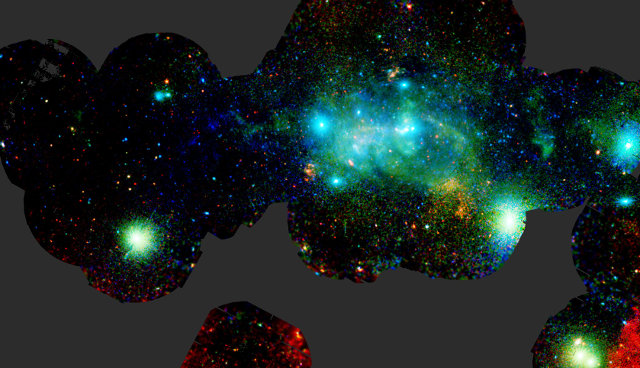
X-ray view of the Milky Way center (Image ESA/XMM-Newton/G. Ponti et al. 2015)

An article published in the journal “Monthly Notices of the Royal Astronomical Society” describes a research about the central region of the Milky Way. Using ESA’s XMM-Newton X-ray space observatory, a team of scientists from the Max Planck Institute for Extraterrestrial Physics (MPE) led by Dr. Gabriele Ponti revealed the most intense processes going on at the center of the galaxy.

The Southern Owl Nebula planetary nebula (Photo ESO)

It’s nicknamed the Southern Owl Nebula and its an extraordinarily symmetrical and round planetary nebula. Using ESO’s VLT (Very Large Telescope) in Chile now it’s been possible to capture an extraordinary image of this dying star and what’s left around it. The result gives the impression of a sphere lit up like a ghost in the darkness of space.

Image showing two pair of stars, one in blue and one in read, born together and then one of them moves far away (Image courtesy Dana Berry/SkyWorks Digital, Inc.; SDSS collaboration)

An article published in recent days in “The Astrophysical Journal” describes a research showing that about 30% of the stars in the Milky Way – which means nearly one in three – moved dramatically from the orbit it had at its birth. This surprising result was achieved by a team of scientists who worked on the Sloan Digital Sky Survey (SDSS) observing for a four-year period 100,000 stars with the SDSS Apache Point Observatory Galactic Evolution Explorer (APOGEE) spectrograph.

Artistic concept of an aurora at the north pole of a brown dwarf (Image Chuck Carter and Gregg Hallinan/Caltech)

Its aurora is 10,000 times more powerful than any other ever seen, somuch as to be detectable, although with very sophisticated instruments, from a distance of 18 light years. It was found on a brown dwarf called LSR J1835+3259 using the Karl G. Jansky Very Large Array (VLA), the Hale Telescope in California and the Keck Telescope in Hawaii. The results of this research have just been published in the journal “Nature”.