Stars

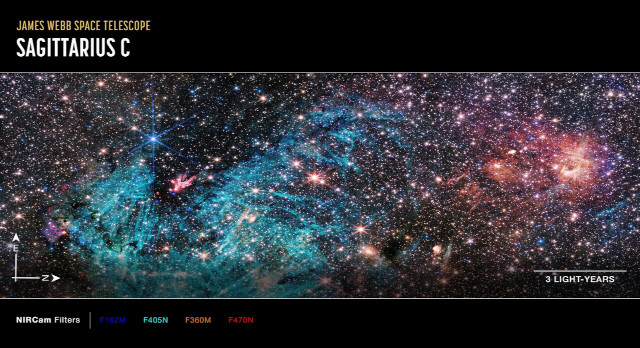
The area cataloged as Sagittarius C

An image captured with the James Webb Space Telescope shows a star-forming area cataloged as Sagittarius C just 300 light-years away from Sagittarius A*, the supermassive black hole at the center of the Milky Way. In the heart of the galaxy, among half a million stars, there’s a cluster of protostars in the middle of a cloud so dense that the stars behind it are obscured even to the most powerful existing telescope. In contrast, protostars are visible to the NIRCam instrument in detail along with cosmic features that were previously unknown and astronomers have yet to identify.

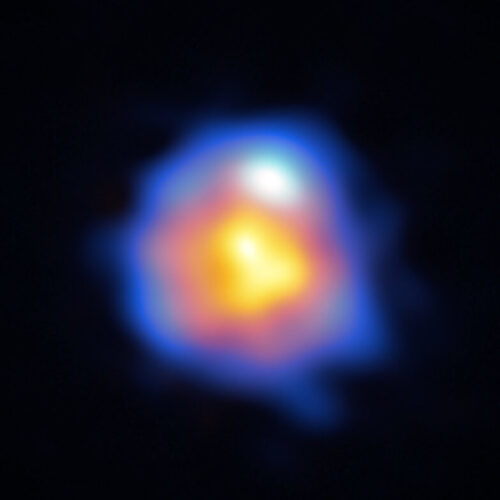
The star R Leporis as seen by the ALMA radio telescope

An article published in “The Astrophysical Journal” reports the results of observations of the star R Leporis conducted using the ALMA radio telescope with its receivers at their highest frequencies and an antenna array configuration spread over an area with a diameter of 16 kilometers. R Leporis, or simply R Lep, is a so-called carbon star, a red giant whose atmosphere is particularly rich in carbon in a phase in which oxygen is normally in greater quantities. Unprecedented observations made it possible to detect details of a natural maser around a star that is reaching the end of its life.

The Perseus galaxy cluster (Image ESA/Euclid/Euclid Consortium/NASA, image processing by J.-C. Cuillandre (CEA Paris-Saclay), G. Anselmi, CC BY-SA 3.0 IGO)

ESA has presented the first official images captured by its Euclid space telescope. After some delays due to problems with the fine guidance sensor, it was possible to calibrate Euclid’s instruments and obtain the extraordinary precision of observations necessary for its mission. The result is a resolution that allows a quantity of detail never seen before to be included in the images, be it galaxies, stars, or other objects, often discovered by Euclid. The presentation showed the results both with distant objects such as the Perseus galaxy cluster and with others close in astronomical terms such as the Horsehead Nebula.

Artist's concept of the Kepler-385 star system (Image NASA/Daniel Rutter)

An article to be published in “The Journal of Planetary Science” reports updates to the catalog of exoplanet candidates discovered with NASA’s Kepler space telescope which offers confirmation of the presence of seven planets in the Kepler-385 star system. This result was obtained by applying examination methods that were significantly improved compared to the past, obtaining new results from old observations. That includes this system among the very few with over six verified or at least candidate planets, making it particularly interesting. However, all of these planets are closer to their star than the inner edge of that system’s habitable zone and receive a significant amount of energy from it. The consequence is that none of them can be similar to Earth.

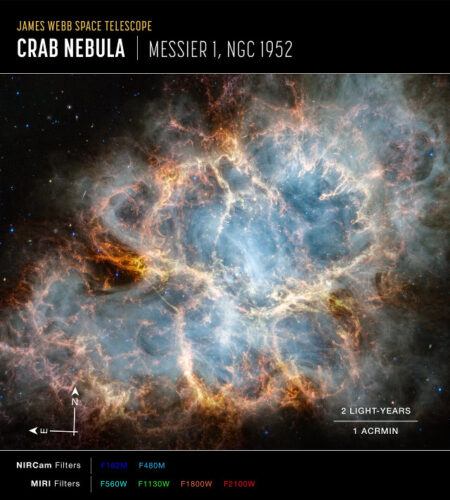
The Crab Nebula as seen by the James Webb Space Telescope

A new image captured by the James Webb Space Telescope depicts the Crab Nebula, the remnants of the supernova spotted on Earth and recorded in 1054, about 6,500 light-years away from Earth. The observation possibilities at the time were limited, to say the least, compared to today’s, so there are still questions regarding that supernova. The NIRCam and MIRI instruments allowed to obtain infrared details showing the synchrotron radiation inside it, produced by the pulsar at its center that formed from the core of the progenitor star that exploded in 1054.