Stars

The HIP 81208 system seen by SPHERE

An article published in the journal “Astronomy & Astrophysics” reports the discovery of an object that could be a gas giant planet or a brown dwarf in the HIP 81208 system. A team of researchers analyzed data from the archive of the observations conducted with the SPHERE instrument mounted on the VLT in Chile discovering an object that was cataloged as HIP 81208 Cb orbiting the smaller of the two stars in this binary system. A brown dwarf was discovered around the more massive star together with the smaller and more distant star in an analysis also published some time ago in an article in “Astronomy & Astrophysics”. The new discovery makes HIP 81208 a so-called hierarchical quadruple system, the first of its kind discovered using a direct imaging system.

A diagram illustrating the combined power of the James Webb and Hubble space telescopes in studying Cepheids present in the galaxy NGC 5584 with the NIRCam (Near-Infrared Camera) and WFC3 (Wide Field Camera 3) instruments, respectively

An article accepted for publication in “The Astrophysical Journal” reports the results of calculating the universe’s expansion rate based on the observation of Cepheids with the James Webb Space Telescope. In particular, a team of researchers led by Adam Riess used the NIRCam instrument to observe over 330 cepheids in the galaxies NGC 4258 and NGC 5584. The results are more precise than those obtained in the past with the Hubble Space Telescope but confirm the accuracy of the previous calculation of the universe’s expansion rate. This leaves open the question of the difference in results obtained with different methods.

Artist's concept of the TOI-4600 system (Image courtesy Tedi Vick)

An article published in the “Astrophysical Journal Letters” reports the discovery of two exoplanets orbiting the star TOI-4600 of which the outermost is the one with the longest year discovered so far. A team of researchers used observations conducted with NASA’s TESS space telescope to find traces of these two gas exoplanets. Other ground-based observatories were used to confirm the existence of these two exoplanets and obtain more information about them. TOI-4600 b has a year of nearly 83 Earth days, a bit shorter than Mercury’s, while TOI-4600 c has a year of nearly 483 days, the longest of all known exoplanets. This is a useful discovery to understand what other planetary systems are like because exoplanets close to their stars are much easier to discover while we still know very little about the ones far from their stars.

The Aditya-L1 space probe at blastoff (Image courtesy ISRO)

A few hours ago, the Indian space probe Aditya-L1 blasted off from the Satish Dhawan space center atop a PSLV-XL rocket. After about ten minutes, it regularly separated from the rocket’s last stage. In about 109 days, Aditya-L1 will reach the Lagrange point called L1, about 1.5 million kilometers from the Earth, where it will begin its mission of observing the solar atmosphere and various processes taking place on the Sun’s surface. It will join other space probes and solar observatories helping to unlock the last secrets of the Sun.

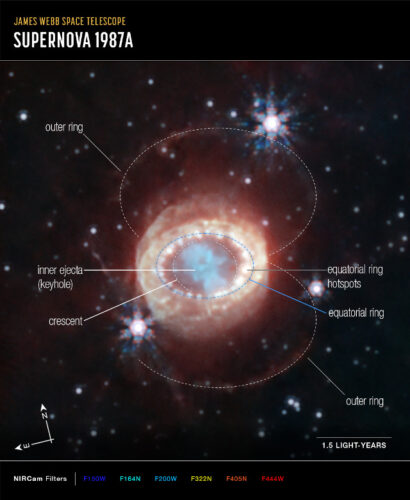
SN 1987A as seen by the James Webb Space Telescope's NIRCam (Near-Infrared Camera) instrument

An image of the remnants of supernova 1987A (SN 1987A) captured by the James Webb Space Telescope caught new details and never-before-seen structures such as the central one, which has a shape like a keyhole, and near it crescent-shaped formations. The NIRCam instrument proves again that it can see where other instruments have seen little or nothing in the decades since the supernova was detected. The aim is always to understand what happens in the years following a supernova to what remains of the star that exploded and to the materials ejected into interstellar space.