Stars

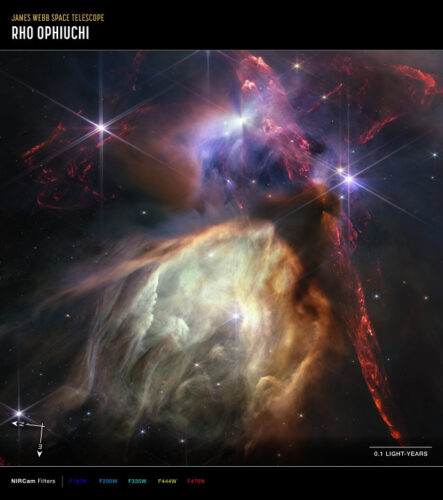
A part of the Rho Ophiuchi complex

An image of part of the Rho Ophiuchi complex captured by the James Webb Space Telescope was chosen to mark the first anniversary of the release of the first official images in astronomy’s new flagship instrument’s science mission. The NIRCam instrument captured details of this giant molecular cloud that forms one of the closest star-forming regions to Earth. Delays and various problems had led to postpone many time Webb’s launch date but in the last year, all the promises of progress in the field of astronomy have been kept and this is only the beginning.

Artist's concept of the exoplanet LTT 9779 b and its star (Image courtesy Ricardo Ramírez Reyes (Universidad de Chile)

An article published in the journal “Astronomy & Astrophysics” reports a study on the exoplanet LTT 9779 b, an ultrahot Neptune that was defined as the largest mirror in the universe because it reflects about 80% of the light it receives from its star. A team of researchers used observations conducted with ESA’s CHEOPS space telescope to study LTT 9779 b. They were able to calculate what is technically called albedo, the amount of light it reflects, in this case at exceptional levels. The conclusion is that such an extreme albedo is due to reflective metal clouds.

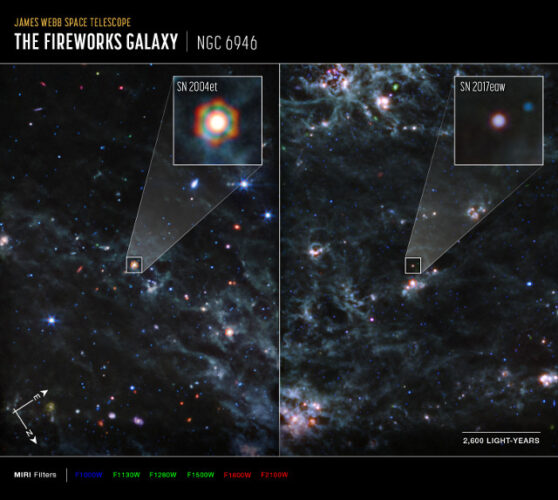
The SN 2004et and SN 2017eaw supernova remnants (Science: NASA, ESA, CSA, Ori Fox (STScI), Melissa Shahbandeh (STScI). Image Processing: Alyssa Pagan (STScI))

An article published in the journal “Monthly Notices of the Royal Astronomical Society” reports the identification of large amounts of dust from two supernovae in the galaxy NGC 6946. A team of researchers used the James Webb Space Telescope to find traces of dust coming from the supernovae SN 2004et and SN 2017eaw exploiting in particular the potential of the MIRI instrument. The result is the discovery of large amounts of dust among the material ejected from each of the two supernovae and this supports the theory that in the early universe, supernovae played a key role in producing dust.

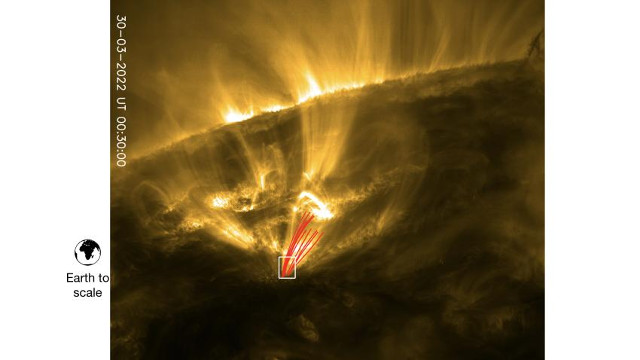
A partial section of the Sun photographed by the Solar Orbiter space probe's EUV instrument with gas at a temperature of around one million degrees Celsius

An article being published in the journal “Astronomy & Astrophysics” reports a study of what were compared to shooting stars, observed in details never obtained before together with the solar corona. A team of researchers coordinated by Northumbria University in Newcastle used observations conducted by ESA’s Solar Orbiter space probe to study what are actually clumps of plasma that can be up to 250 kilometers wide, a coronal rain that falls on the surface of the Sun. That plasma heats up to a few million degrees, a state that lasts a few minutes during the fall until it condenses following its quick drop in temperature.

The so-called ultradeep field used in the MIDIS survey and on the right, some of the primordial galaxies at the center of this study are highlighted in the circle

An article published in “The Astrophysical Journal Letters” reports a study indicating that the early universe was much brighter than predicted by simulations based on current cosmological models. A team of researchers coordinated by the Center for Astrobiology (CAB) in Madrid, Spain, used observations conducted with the James Webb Space Telescope to examine galaxies that formed between 200 and 500 million years after the Big Bang. The combination of observations conducted with the NIRCam instrument and the MIRI Deep Imaging Survey (MIDIS) of the Hubble Ultra Deep Field (HUDF) on a sample of 44 primordial galaxies shows their surprising brightness and compactness.