Stars

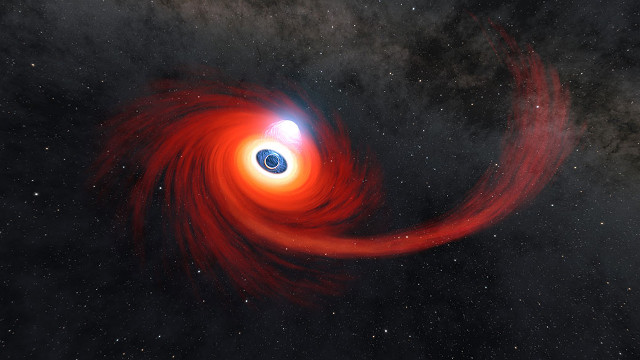
Artist's impression of a magnetar eruption. (Image NASA's Goddard Space Flight Center)

An article published in the journal “Nature Astronomy” reports an explanation for the abrupt slowdown in the rotation of the magnetar cataloged as SGR 1935+2154 and its attribution to a sort of volcano that ejected a kind of wind into space. A team of researchers used X-ray data from ESA’s XMM-Newton space telescope and NASA’s NICER instrument to analyze changes in the magnetar. Their conclusion is that the activity of the pseudo-volcano altered the magnetar’s magnetic field, slowing down its rotation, what in jargon is called anti-glitch. That led to the beginning of radio wave emissions subsequently detected by the Chinese FAST radio telescope.

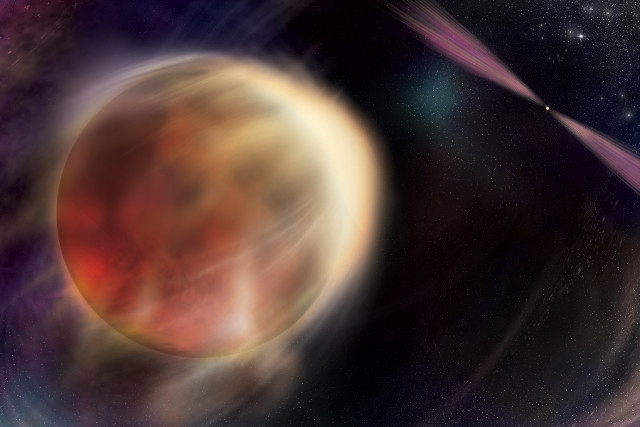
Artist's impression of a binary system containing a spider pulsar (Image NASA/Sonoma State University, Aurore Simonnet)

An article published in the journal “Nature Astronomy” reports the detection of gamma-ray eclipses in binary systems formed by a normal star or a brown dwarf that have a pulsar as a companion that is defined as a spider pulsar because they steal gas from the companion behaving like a black widow. A team of researchers used data collected over a decade by NASA’s Fermi Space Telescope to find cases in which the star passes in front of the pulsar. Seven binaries have been identified with a spider pulsar being eclipsed by its companion. This identification made it possible to measure the pulsar’s mass, a result useful to conduct tests on the theory of relativity and understand the behavior of matter in extreme conditions.

The new scheme of the orbits of the planets of the TOI 700 system

An article accepted for publication in “The Astrophysical Journal Letters” reports the discovery of the exoplanet TOI 700 e. A team of researchers used observations conducted with NASA’s TESS space telescope and confirmed with other instruments to find it. It’s the fourth planet discovered in the TOI 700 red dwarf system and is interesting because it’s a rocky planet a bit smaller than Earth. Its habitability potential is yet to be assessed because it’s within the so-called optimistic habitable zone, where a planet can only have liquid water on its surface for part of its history.

The galaxy clusters MOO J1014+0038 (left panel) and SPT-CL J2106-5844 (right panel) as seen by the Hubble Space Telescope's Wide Field Camera 3 instrument at infrareds

An article published in the journal “Nature” reports the results of a study on the so-called intracluster light that permeates galaxy clusters. Hyungjin Joo and M. James JeeĀ of Yonsei University in Seoul, South Korea, used the Hubble Space Telescope to examine ten galaxy clusters and the glow within them. The surprising and therefore interesting discovery was that intracluster light is abundant even in the oldest clusters, a sign that the stars that emit it were ejected from their galaxies a long time ago. This suggests that this happened at the same time as the formation and growth of the clusters.

Artist's illustration of a tidal disruption event (Image NASA/JPL-Caltech)

An article published in “The Astrophysical Journal” reports the results of the observations of a supermassive black hole that is destroying a star. Cataloged as AT2021ehb, this is an event of the type technically called a tidal disruption event. A team of researchers used observations conducted with NASA’s NuSTAR and Swift space telescopes, the NICER instrument on the International Space Station, and other instruments to cover 430 days of the evolution of this process. This will help understand what happens to materials captured by a supermassive black hole before they’re completely swallowed.