Stars

An article published in “The Astrophysical Journal Letters” reports a study on the exoplanet Kepler-1658b which predicts the decay of its orbit until it’s destroyed by its star. A team of researchers used data gathered from observations conducted over several years, from those by the Kepler Space Telescope that discovered Kepler-1658b to those by the TESS Space Telescope to examine its orbit. The conclusion is that this gas giant is slowly approaching its star and will be destroyed in the future.

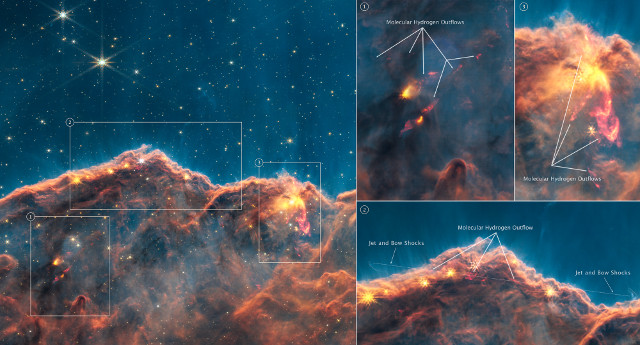
The Cosmic Cliffs and in the insets on the right side the details of some areas with indications of hydrogen outflows, jets, and bow shocks, the shock waves caused by that activity

An article published in the journal “Monthly Notices of the Royal Astronomical Society” reports a study of the open cluster NGC 3324, part of the Carina Nebula, one of the largest known star nurseries. A team of researchers used observations conducted with the James Webb Space Telescope to specifically study an area on the edge of NGC 3324 nicknamed the Cosmic Cliffs. The nickname is due to the jagged appearance like a cliff but instead of water and rocks, there’s an expanse of gas and dust. The amplitude of the infrared frequencies detected by Webb made it possible to obtain more details than ever of what is happening in the midst of those cosmic clouds, finding 24 new outflows of molecular hydrogen associated with as many protostars.

The galaxies RS13 and RS14 as they appeared in images captured by the Spitzer Space Telescope and as they appear in the image captured by Webb

An article published in “The Astrophysical Journal Letters” reports the identification of a population of rare red spiral galaxies in the SMACS J0723.3-7327 galaxy cluster. A team of researchers used observations conducted with the James Webb Space Telescope to find details of these galaxies which are estimated to date back to when the universe was about two to three billion years old.

The unprecedented detail captured by Webb helps to make progress in understanding the processes taking place in galaxies of various ages and understand why some appear red. Finding several very old ones suggests that over 10 billion years ago, red galaxies were more common.

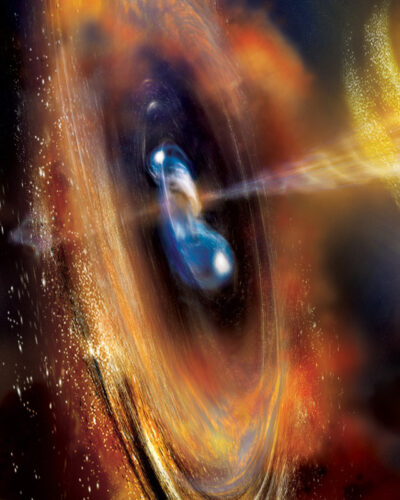
Artist's representation of a merger between two neutron stars (Image A. Simonnet (Sonoma State Univ.) and NASA’s Goddard Space Flight Center)

Three articles published in the journal “Nature” and one article published in the journal “Nature Astronomy” report various aspects of the studies conducted on the out-of-normal gamma-ray burst cataloged as GRB 211211A. Various teams of researchers used observations conducted with a series of ground-based and space telescopes to examine an event that lasted more than two hours after the actual burst. At that time, the gravitational wave detectors were not active but the event’s characteristics indicate that the origin is in a kilonova, a merger between two neutron stars.

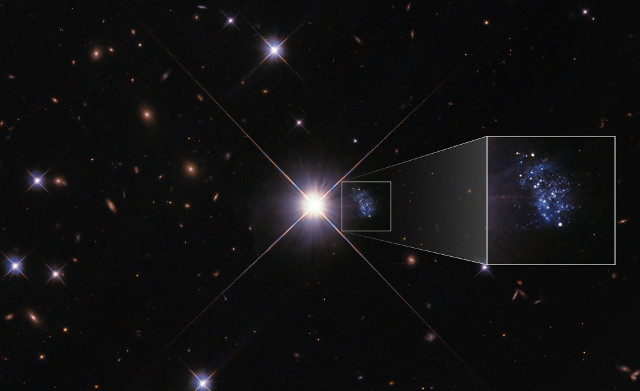
HIPASS J1131–31 / Peekaboo, magnified in the inset (Image Science: NASA, ESA, Igor Karachentsev (SAO RAS) image processing: Alyssa Pagan (STScI))

An article accepted for publication in the journal “Monthly Notices of the Royal Astronomical Society” reports a study of a dwarf galaxy cataloged as HIPASS J1131–31 that is relatively close but has the characteristics of a primordial galaxy. A team of researchers combined observations from various ground-based and space telescopes to confirm its nature, including the Hubble Space Telescope. They nicknamed it Peekaboo because it peeks out from behind a bright star that hid it for a long time and made it difficult to identify. It’s a very small galaxy but its primordial characteristics make it interesting for astronomers.