Stars

Webb's First Deep Field (Image NASA, ESA, CSA, and STScI)

NASA has released the first official images captured by the James Webb Space Telescope. The presentation was made in collaboration with ESA and CSA (Canadian Space Agency), the other space agencies that work together with NASA on the project and its management. Yesterday, when it was afternoon at the White House, US President Joe Biden personally presented the top image, Webb’s First Deep Field image that includes the SMACS 0723 galaxy cluster as a preview, a proof of the importance of this space telescope.

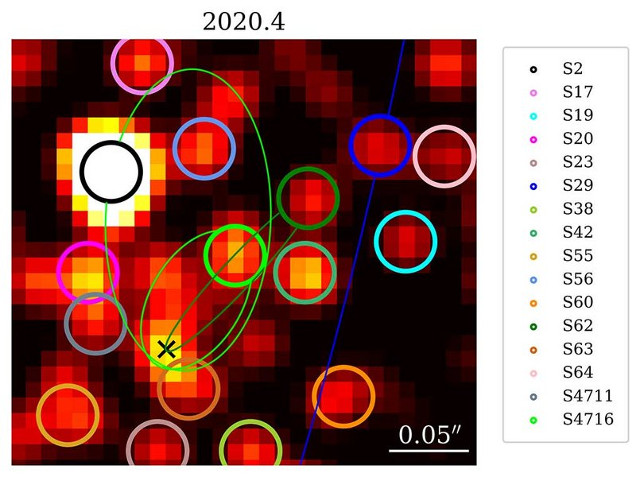
16 stars of the S cluster

An article published in “The Astrophysical Journal” reports the identification of the star with the closest orbit around Sagittarius A*, the supermassive black hole at the center of the Milky Way. A team of researchers cataloged it as S4716 after finding it in data collected over twenty years with the Keck Observatory, the VLT, and the VLTI. The star S4716 completes an orbit in about 4 Earth years and its distance from Sagittarius A* is as close as 100 times the Earth’s from the Sun. Its discovery, which breaks the record of the star S4711, is surprising and will help to better understand how stars in that area formed and moved, as it’s difficult to think that it formed this close to a supermassive black hole.

The ultra-faint dwarf galaxy Pegasus V

An article submitted for publication in the journal “Monthly Notices of the Royal Astronomical Society” reports the identification of an ultra-faint dwarf galaxy that was named Pegasus V near the Andromeda galaxy. A team of researchers conducted follow-up observations following the discovery made by an amateur astronomer and, using the GMOS instrument mounted on the Gemini North telescope in Hawaii, confirmed its existence. An interesting result of the observations is the very limited presence of elements heavier than hydrogen and helium, a discovery that led to the conclusion that it’s a kind of fossil of a primordial galaxy.

A comparison between the Earth and the exoplanet TOI-1807 b (Image Nardiello/NASA – Eyes-on-exoplanets)

An article published in the journal “Astronomy & Astrophysics” reports a study of the exoplanet TOI-1807 b, a rocky planet discovered in 2020 thanks to NASA’s TESS space telescope. A team of researchers led by the Italian National Institute of Astrophysics and the University of Padua used the HARPS-N spectrograph installed on the Galileo National Telescope in the Canary Islands to conduct follow-up examinations of TOI-1807 b. The conclusion is that it’s a slightly larger exoplanet than Earth but the main peculiarity is that it’s the youngest of the type with an ultra-short period orbit, as it’s estimated to be around 300 million years old and its year lasts about 13 hours.

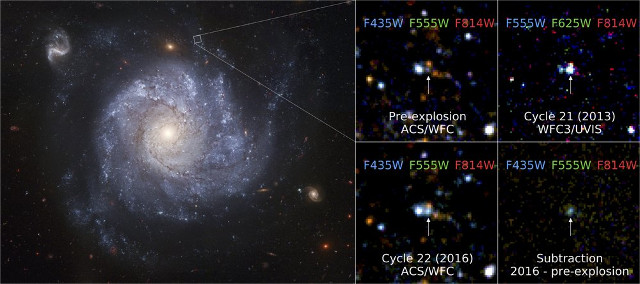
On the left the galaxy NGC 1309 and on the right images of the area where the supernova SN 2012Z occurred, captured over the years

An article published in “The Astrophysical Journal” reports a study of the consequences of the supernova cataloged as SN 2012Z, considered to be of the type Iax, which means that it’s the explosion of a white dwarf. A team of researchers used the Hubble Space Telescope to study its remnants and found that the star survived the supernova and is even brighter than before. One possibility is that the explosion was too weak to scatter the remnants of the white dwarf into interstellar space with the result that they started re-aggregating.