Stars

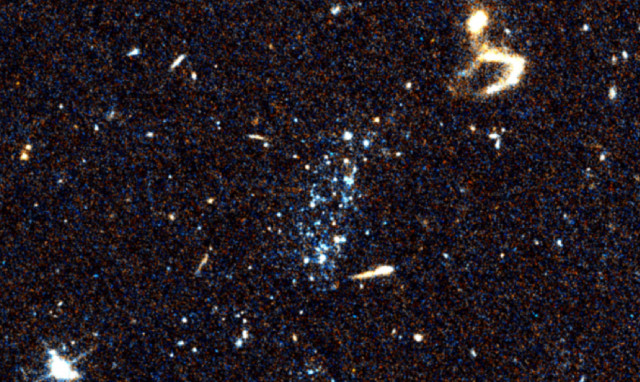
One of the star systems discovered in the Virgo cluster seen by the Hubble Space Telescope (Image courtesy Michael Jones)

An article submitted for publication to “The Astrophysical Journal” reports the discovery of star systems that are even smaller than a dwarf galaxy and are isolated from any normal galaxy. A team of researchers examined a catalog of gas clouds found in a previous survey looking for new galaxies and found small clusters that contain mostly young blue stars scattered irregularly within the Virgo galaxy cluster. These are cases similar to the one cataloged as SECCO 1, another system discovered in the Virgo cluster and reported in an article published in February 2018 in the journal “Monthly Notices of the Royal Astronomical Society”. The discovery of other such groups may help to understand their origin.

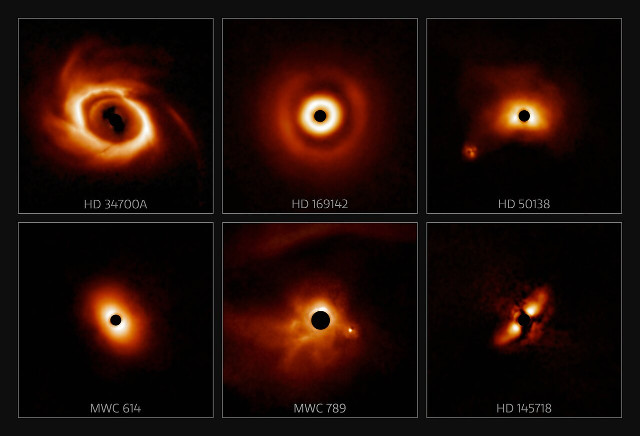
6 of the systems studied in the Gemini-LIGHTS survey

An article accepted for publication in “The Astronomical Journal” reports the results of the Gemini-LIGHTS survey on 44 young massive stars. A team of researchers used the Gemini Planet Imager (GPI) mounted on the Gemini South telescope in Chile to study the disks of materials around these stars to see if planets and ring structures have formed inside them. The results revealed the presence of possible planets and even brown dwarfs with differences between disks surrounding stars up to three times the mass of the Sun and disks surrounding more massive stars.

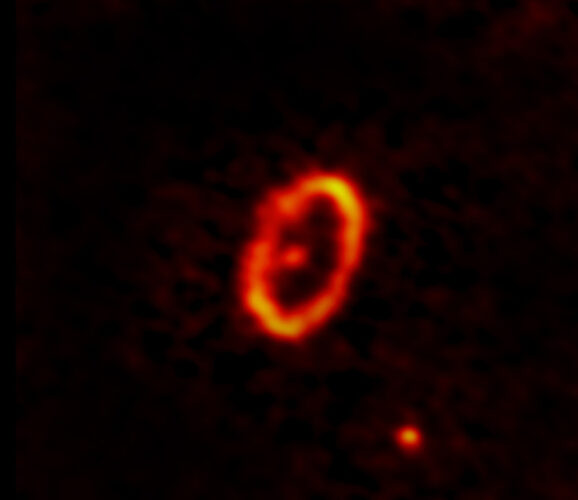
The HD 53143 system seen by ALMA (Image ALMA (ESO/NAOJ/NRAO)/M. MacGregor (U. Colorado Boulder); S. Dagnello (NRAO/AUI/NSF))

An article accepted for publication in “The Astrophysical Journal Letters” reports the results of a study of the young system of HD 53143, in which a Sun-like star is surrounded by a disk of materials with a structure different from all those known so far which could include a planet. A team of researchers used the ALMA radio telescope to study that disk, which is very eccentric instead of being circular with the star in its center. The disk around HD 53143 has an elliptical shape and the star is in one of the foci of the ellipse, far from the center. The results were presented at the 240th meeting of the American Astronomical Society (AAS) held these days in Pasadena, California.

Infographic that shows the various subsets of data covering a total of approximately 1,800,000,000 stars observed by the Gaia space probe

ESA has released the third 3D map of the sky including the Milky Way and nearby galaxies obtained from the Gaia space probe, the most detailed of its kind ever produced. This catalog, built thanks to what was called Data Release 3 (DR3), greatly expands the previous maps released by ESA in recent years. Some uncertainties regarding data processing, also caused by the start of the pandemic, led ESA to publish an anticipation of DR3 called EDR3 (Early Data Release 3) on December 3, 2020.

The FRB 190520B fast radio burst area (in red) as seen by the VLA radio telescope (Image Niu, et al.; Bill Saxton, NRAO/AUI/NSF; CFHT)

An article published in the journal “Nature” reports the identification of a new fast radio burst which was cataloged as FRB 190520B. A team of researchers made this discovery thanks to the FAST radio telescope in China. Recently, the number of known fast radio bursts has increased significantly but in this case, it’s a repeating phenomenon that makes it rare and particularly interesting. FRB 190520B has characteristics that are different from other fast radio bursts because it repeats, just like the one cataloged as FRB 121102. Magnetar-type neutron stars are the most likely candidates as sources of these emissions and the magnetar that generates FRB 190520B may have just formed after a supernova.