Stars

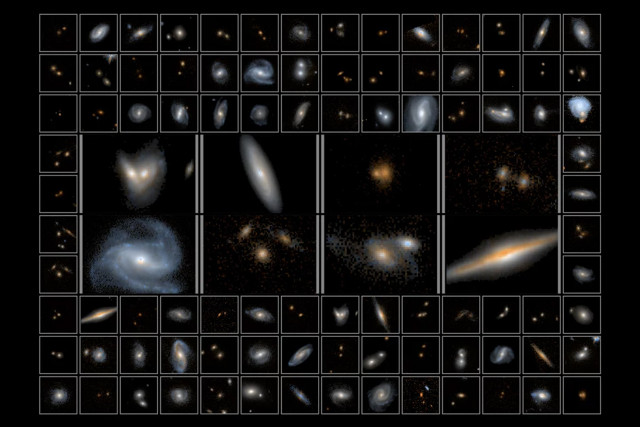
Some of the galaxies observed in the 3D-DASH survey

An article accepted for publication in “The Astrophysical Journal” reports the release of the results of the 3D-DASH survey, which aims to map star-forming regions to understand the formation of the most ancient galaxies, which from the Earth’s point of view are the most distant. A team of researchers used the Hubble Space Telescope to capture near-infrared images in the area known as the COSMOS (Cosmic Evolution Survey) field, a previous survey conducted with Hubble.

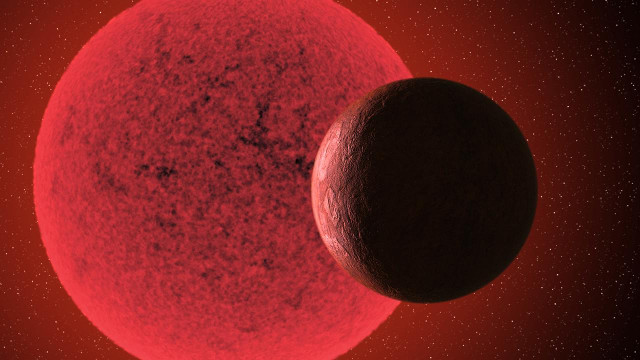
Artist's concept of a super-Earth orbiting close to a red dwarf (Image courtesy Gabriel Pérez Díaz, SMM (IAC))

An article accepted for publication in the journal “Publications of the Astronomical Society of Japan” reports the discovery of the exoplanet Ross 508 b, probably a super-Earth at the edge of ​​its star system’s habitable zone. A team of researchers led by Hiroki Harakawa used the IRD (InfraRed Doppler) instrument mounted on the Subaru Telescope to examine the star Ross 508, a red dwarf that has a mass that is only 18% of the Sun’s. The radial velocity method allowed to identify what from the collected data looks like a rocky planet with a mass that is about 4 times the Earth’s. This discovery confirms the value of infrared spectroscopic examinations of red dwarfs.

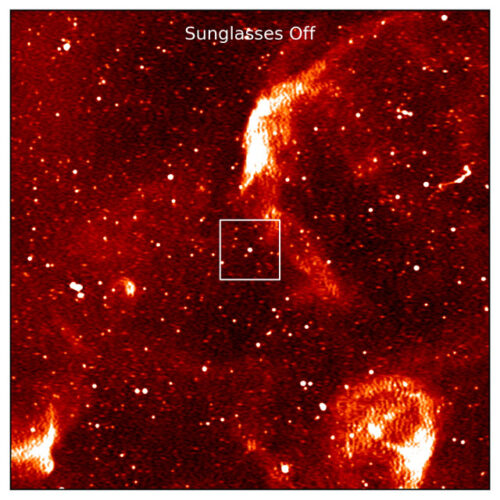
The pulsar PSR J0523-7125 in the square seen by MeerKAT (Image courtesy Yuanming Wang)

An article published in “The Astrophysical Journal” reports the discovery of a pulsar cataloged as PSR J0523-7125, the brightest pulsar discovered outside the Milky Way. A team of researchers led by Tara Murphy of the Australian University of Sydney used a new technique based on the analysis of the polarization of the light emitted by the pulsar to identify it among the observations conducted with the ASKAP radio telescope. The polarization was crucial in the identification because it made it possible to understand that the light came from a pulsar and not from an object of another type.

Artist's concept of RS Ophiuchi showing the white dwarf stealing gas from its companion (Image courtesy DESY/H.E.S.S., Science Communication Lab)

An article published in the journal “Nature Astronomy” reports a study of the recurrent nova known as RS Ophiuchi based on the detection of the gamma rays emitted by the last outburst that occurred on the white dwarf part of the pair. MAGIC Collaboration researchers examined data collected by the MAGIC telescopes and concluded that outbursts of that type generate some of the gamma rays present in the Milky Way.

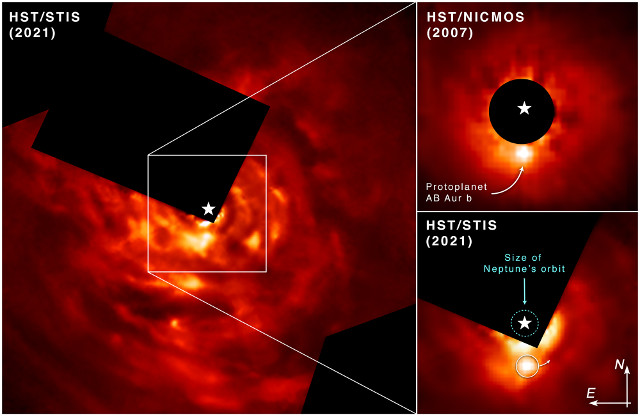
The AB Aurigae system and its protoplanet seen by Hubble

An article published in the journal “Nature Astronomy” reports a study on the protoplanet cataloged as AB Aurigae b, a gas giant that is growing following an unusual process called disk instability. A team of researchers used observations made with the Hubble Space Telescope and the Subaru Telescope on Mauna Kea, Hawaii, between 2007 and 2021 to find evidence of that violent formation. Proving that gas giants can form as a result of disk instability will help better understand the history of the solar system as well.