Stars

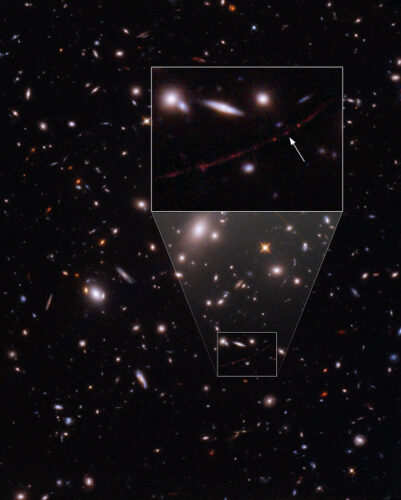
Earendel, indicated by an arrow, seen by Hubble (Image NASA, ESA, B. Welch (JHU), D. Coe (STScI), A. Pagan (STScI) )

An article published in the journal “Nature” reports the discovery of the most distant single star, nicknamed Earendel. A team of researchers used data collected during the RELICS (Reionization Lensing Cluster Survey) program using the Hubble Space Telescope to search for the brightest galaxies dating back to the first billion years of the universe’s life. A large galaxy cluster cataloged as WHL0137-08 distorted the image of very distant galaxies in a gravitational lensing effect to the point that it can detect a single star about 12.9 billion light-years away from Earth. Earendel’s study, whose mass was estimated to be at least 50 times the Sun’s, will help to better understand the formation and evolution of the very first generations of stars in the universe.

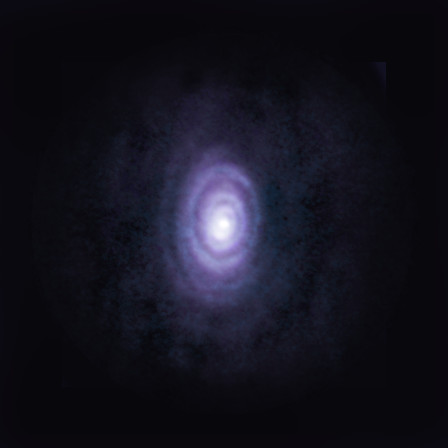
The star V Hydrae and its rings seen by ALMA (Image ALMA (ESO/NAOJ/NRAO)/S. Dagnello (NRAO/AUI/NSF))

An article accepted for publication in “The Astrophysical Journal” reports the results of a study of the star V Hydrae that includes the discovery of a system of six rings that surround it and are expanding and two hourglass structures. A team led by Raghvendra Sahai of NASA’s JPL used the ALMA radio telescope and data collected with the Hubble Space Telescope to study the materials that were ejected by V Hydrae in the agony that will lead to its death. These observations can provide valuable information to better understand the processes taking place during a relatively short phase that for this reason is difficult to observe.

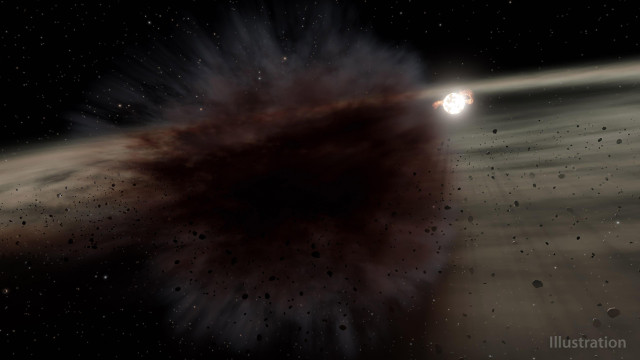
Artist's concept of a cloud of debris in the system of the star HD 166191 (Image NASA/JPL-Caltech)

An article published in “The Astrophysical Journal” reports a study on the star system cataloged as HD 166191, which has an estimated age of 10 million years and is still in its formation process with objects that form but also get destroyed following collisions. A team of researchers led by Kate Su of the University of Arizona used data collected between 2015 and 2019 using NASA’s Spitzer Space Telescope and ground-based telescopes to detect traces of debris clouds generated by collisions between planetesimals. The information obtained from these data is very useful to improve our knowledge of the formation and evolution of planetary systems.

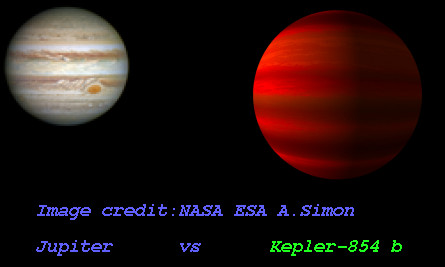
Artist's concept of Kepler-854b as en exoplanet compared to Jupiter

An article published in “The Astronomical Journal” reports a study that reviews the data of four objects discovered a few years ago thanks to NASA’s Kepler space telescope, concluding that at least three of them are actually tiny stars and not planets. A team of researchers used new data collected by ESA’s Gaia space probe to get more precise information on objects cataloged as exoplanets. Kepler-854b, Kepler-840b, and Kepler-699b appear to have sizes between two and four times Jupiter’s, too much even for hot Jupiters very close to their stars but possible for tiny stars. Kepler-747b turns out to have a radius 1.8 times Jupiter’s even though it’s quite far from a star a little smaller than the Sun, so its nature is uncertain.

The pulsar j2030 and part if its filament seen at X-rays and optical frequencies

An article accepted for publication in “The Astrophysical Journal” reports a study on the long filament generated by the pulsar cataloged as PSR J2030+4415, or simply J2030. Martjin de Vries and Roger Romani of the American Stanford University used observations made using NASA’s Chandra X-ray Observatory and ground-based telescopes to study a filament that has an estimated length of about 7 light-years and is composed of matter but also of antimatter. Pulsar emissions of this type could explain positron detections in the Milky Way.