Stars

The Eta Carinae system

A new image portrays Eta Carinae bringing together observations in various bands of the electromagnetic spectrum from infrareds to X-rays thanks to the Hubble, Chandra, and Spitzer space telescopes. Each frequency offers some specific data on this pair of stars especially famous for the so-called Great Eruption that made it particularly bright for many years with a peak in 1843. The data put together also allowed to create 3D models of the Homunculus Nebula and gas and dust clouds surrounding the pair. This is useful research for astronomers to understand the evolution of Eta Carinae and also from an educational point of view within NASA’s Universe of Learning program.

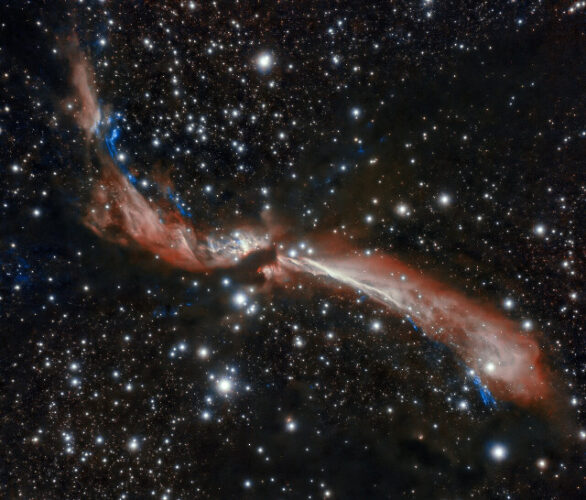
The jet MHO 2147 (Image International Gemini Observatory/NOIRLab/NSF/AURA. Acknowledgments: PI: L. Ferrero (Universidad Nacional de Córdoba))

An article published in the journal “Astronomy and Astrophysics” reports observations of stellar jets cataloged as MHO 2147 and MHO 1502 emitted by two protostellar sources. A team of researchers used the Gemini South telescope in Chile to study those jets, which have an appearance that is likely influenced by the gravitational pull of companion stars. The quality of the observations is due to the adaptive optics system designed to compensate for the distortion caused by the Earth’s atmosphere.

Artist's concept of the exoplanet Wasp-103b and its star (Image ESA)

An article published in the journal “Astronomy & Astrophysics” reports a study of the exoplanet Wasp-103b that offers evidence of its oval shape. A team of researchers used data collected by ESA’s CHEOPS space telescope to have the accuracy needed to assess this gas giant’s anomalous shape. It’s due to its star’s powerful tidal forces, as the star is a bit larger and more massive than the Sun, on this planet due to their proximity. In fact, Wasp-103b is so close to its star that its year lasts a little less than an Earth day.

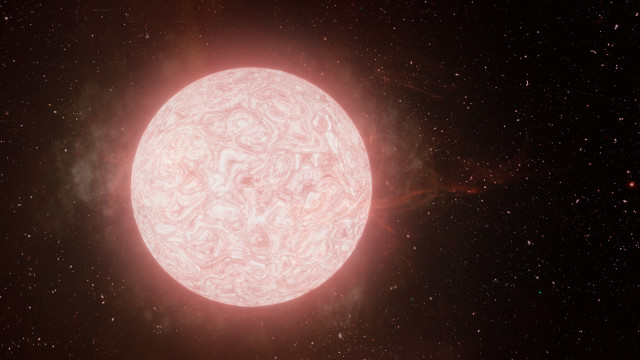
Artist's concept of a red supergiant star exploding (Image courtesy W.M. Keck Observatory/Adam Makarenko)

An article published in “The Astrophysical Journal” reports the observations of the supernova cataloged as SN 2020tlf, the first case in which astronomers observed a red supergiant star in the period immediately preceding the explosion. A team of researchers used the Pan-STARRS telescope in Hawaii to detect the changes taking place in the red supergiant in the summer of 2020 and then used the NIRES and DEIMOS instruments of the Keck Observatory, also in Hawaii, for the first spectrographic detections of the supernova emissions in the fall of 2020. Subsequently, other instruments added data on the supernova. Astronomers expected a red supergiant to go through a quiet period before exploding, but SN 2020tlf’s progenitor emitted strong radiation in the last year of its life.

An illustration of the Milky Way and the Magellanic Clouds with C-19 on the left side

An article published in the journal “Nature” reports the discovery of a primordial stellar stream at the edge of the Milky Way cataloged as C-19. A team of researchers used the GRACES instrument on the Gemini North telescope in Hawaii to study this stellar stream discovered in data collected by the Gaia space probe. The stars that are part of C-19 were identified in the Pristine survey as well, which aims to search for stars with the lowest metallicity in the Milky Way with the CFHT (Canada-France-Hawaii Telescope), also at Hawaii. Further data was collected using the Gran Telescopio Canarias in the Canaries. The study’s conclusion is that C-19’s stars were torn from an ancient star cluster when the Milky Way was very young. This new information could help better understand the formation of the first stars.