Stars

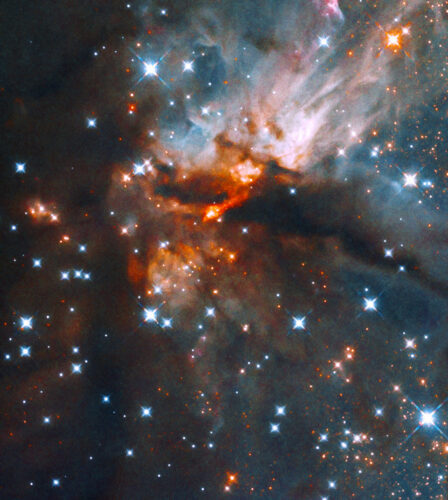
The G035.20-0.74 nebula (Image NASA, ESA, and J. Tan (Chalmers University of Technology); Processing; Gladys Kober (NASA/Catholic University of America))

NASA has released an image captured by the Hubble Space Telescope of the nebula cataloged as G035.20-0.74, a star nursery in the constellation Aquila. In this specific case, the stars that are born are really massive, B-Type blue giants that are up to five times hotter than the Sun. Their formation is among the astronomers’ research objects and within G035.20- 0.74 there’s a massive protostar that is emitting jets of gas. It’s a phenomenon known in protostars but it’s difficult to observe in the ones so massive, which tend to be surrounded by larger quantities of dust that hide them.

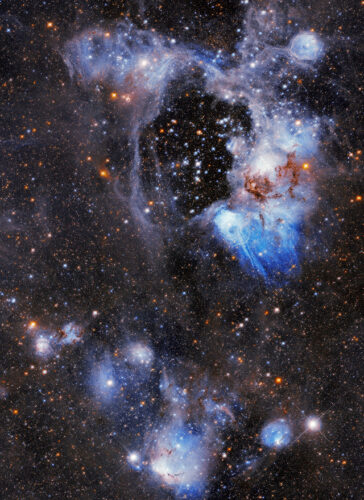
The N44 nebula (Image NASA, ESA, V. Ksoll and D. Gouliermis (Universität Heidelberg), et al.; Processing: Gladys Kober (NASA/Catholic University of America))

NASA has released an image captured by the Hubble Space Telescope of N44, an emission nebula in the Large Magellanic Cloud. Its classification is due to the fact that it glows because of electromagnetic emissions generated by the ionization caused by the stars present in that area. A really curious formation inside it is what was called a superbubble, a kind of cavity inside N44 that’s still without a certain explanation. The stellar winds in the nebula don’t seem to have the necessary characteristics, so the most widely considered hypothesis is that the cavity was excavated by supernovae.

Three galaxies simulated in the IllustrisTNG Project

An article published in “The Astronomical Journal” reports the first results of an analysis of the data of the Data Release 3 (DR3) of the Lega-C astronomical survey, the largest spectroscopic survey of galaxies that we could define in their midlife since we see them as they were between about five and eight billion years ago. It offers information crucial to fully understand certain phases of the evolution of galaxies and star formation within them. Good news offered by a team of researchers led by Po-Feng Wu of the Institute of Astronomy and Astrophysics in Taipei (Taiwan) is the good consistency between the simulations of the IllustrisTNG program and of the observations conducted in that sort of census that was Lega-C.

The galaxy protocluster G237

Two articles, one published in the journal “Astronomy & Astrophysics” and one in the journal “Monthly Notices of the Royal Astronomical Society”, report various aspects of the discovery of a galaxy protocluster in which there was an extraordinary rate of star formation when the universe was about 3 billion years old. A team of researchers led by Mari Polletta of the Italian National Institute of Astrophysics, Milan, found traces of the protocluster G237.01+42.50, or simply G237, in the data collected by the Planck Surveyor space probe and then used various telescopes to observe the galaxies inside it. The results were collected by a team led by Yusei Koyama of the National Astronomical Observatory, Japan.

M51 and an illustration of the system that could host an exoplanet

An article published in the journal “Nature Astronomy” reports the identification of a candidate exoplanet in another galaxy, cataloged as M51-ULS-1b. A team of researchers used NASA’s Chandra X-ray Observatory and ESA’s XMM-Newton Space Telescope to examine what could be the transit of a Saturn-sized exoplanet in M51, a pair of galaxies. In the larger of the two galaxies, there’s an ultra-luminous X-ray source consisting of a dead star and a blue supergiant, and the candidate exoplanet orbits them. The first confirmation of an extragalactic exoplanet would be extraordinary but in this case, not all alternative explanations can be completely ruled out.