Stars

The exoplanet 2M0437b near its star

An article published in the journal “Monthly Notices of the Royal Astronomical Society” reports the discovery of a newborn planet orbiting the red dwarf star 2M0437. A team coordinated by the University of Hawaii at Mānoa used various telescopes to confirm that the discovered object was a planet orbiting that star and to capture a direct image of it. 2M0437b is one of the youngest exoplanets discovered so far, born together with its star in the Taurus Cloud, a stellar nursery that has been the subject of various astronomical studies.

The galaxies NGC 4567 (top) and NGC 4568 (bottom) with supernova SN 2020fqv in the inset

An article to be published in the journal “Monthly Notices of the Royal Astronomical Society” reports observations of a supernova that was cataloged as SN 2020fqv in the galaxy NGC 4568. A team of researchers used the Hubble Space Telescope combining data collected with other instruments to study this supernova starting from the first moments of the explosion. Information on the last moments of the progenitor star’s life, on the materials very close to the supernova ejected from the star in the last year of its life, and on the first phase of the supernova will help find the signs of other upcoming supernovae.

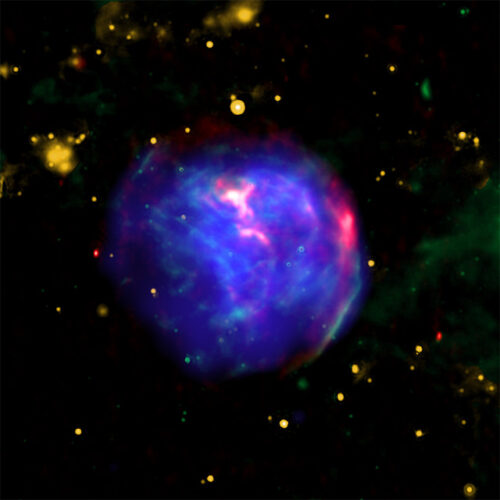
Composite image of G344.7-0.1 (X-ray: NASA/CXC/Tokyo Univ. of Science/K. Fukushima, et al.; IR: NASA/JPL/Spitzer; Radio: CSIRO/ATNF/ATCA)

An article published in “The Astrophysical Journal” reports a study on the supernova remnants cataloged as G344.7-0.1. A team of researchers combined observations in different bands of the electromagnetic spectrum to study the consequences of a Type Ia supernova, the explosion of a white dwarf that reached critical mass after stealing gas from a companion. These remnants can show in particular the effects of what is called reverse shock and offer new information to better understand these supernovae, important in the creation of elements such as iron that are scattered in interstellar space.

Artist's concept of red dwarf magnetically interacting with a planet (Image courtesy Danielle Futselaar (artsource.nl))

Two articles – one published in the journal “Nature Astronomy” and one published in “The Astrophysical Journal Letters” – report different aspects of the discovery of radio wave emissions from 19 red dwarfs of which at least 4 could have originated from interaction with unknown planets. This study is based on detections obtained with the LOFAR radio telescope to examine the stellar magnetic activity of 19 red dwarfs. Radio emissions have also been detected from ancient and magnetically inactive stars. Data collected by NASA’s TESS space telescope was also added to get a more complete picture of that activity. The most likely explanation is that there’s an interaction with the magnetic field of planets that haven’t been detected.

GW Orionis' protoplanetary dsk

An article published in the journal “Monthly Notices of the Royal Astronomical Society” reports a study on the triple system of GW Orionis, or simply GW Ori, which claims that there is at least one exoplanet, which would be the first known to orbit three stars. A team of researchers led by Jeremy Smallwood of the University of Nevada Las Vegas examined observations of the rings of GW Ori’s protoplanetary disk made with the ALMA radio telescope. The goal was to try to establish the cause of the presence of void within one of them and the conclusion is that one or more exoplanets have formed or are forming.