Stars

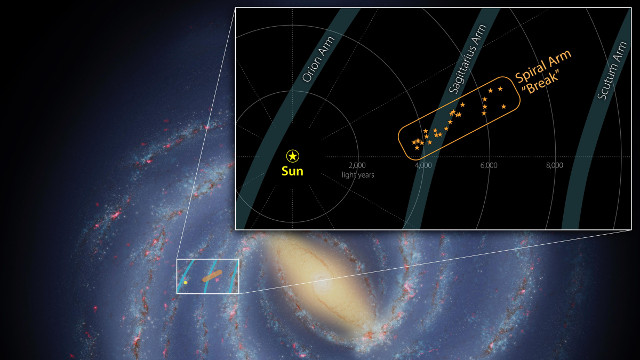
A reconstruction of the Milky Way, the Sagittarius Arm and its "splinter"

An article published in the journal “Astronomy & Astrophysics” reports the discovery of an anomalous structure in the Milky Way’s Sagittarius Arm. A team of researchers used observations made with NASA’s Spitzer Space Telescope and data collected by ESA’s Gaia space probe to locate a structure about 3,000 light-years long that has an orientation that’s very different from the rest of the Sagittarius Arm. Such structures have been identified in other galaxies but it’s the first time that one of them has been identified within the Milky Way. That’s not a surprise, as it’s difficult to study such large structures of the galaxy from the inside.

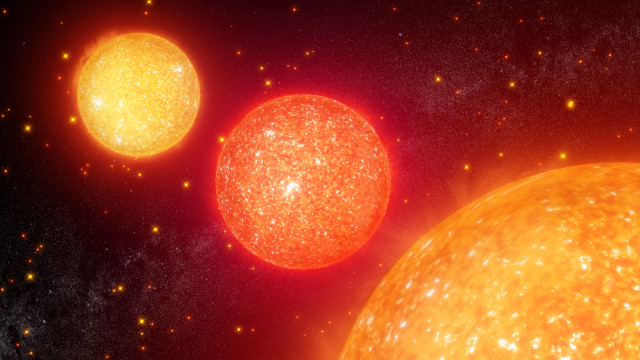
Artist's concept of red giants (Image NASA’s Goddard Space Flight Center/Chris Smith (KBRwyle))

An article accepted for publication in “The Astrophysical Journal” reports the discovery of a total of 158,505 pulsating red giants. A team of researchers used the map of most of the sky created thanks to NASA’s TESS space telescope and, taking advantage of the quality of those observations, identified an unprecedented amount of this type of stars. The map analysis was conducted using a machine learning system trained to detect the traces of the oscillations in the stellar spectra of red giants. This is a very useful result for the studies of astroseismology, a branch of astronomy that studies the structure and properties of stars by analyzing their pulsations. Marc Hon of the University of Hawaii presented the results at the second TESS Science Conference, held virtually in recent days.

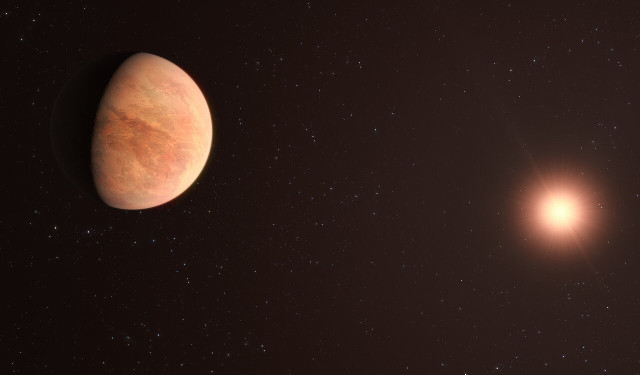
Artist's concept of the exoplanet L 98-59b and its star (Image ESO/M. Kornmesser)

An article published in the journal “Astronomy & Astrophysics” reports a study on the planets orbiting the red dwarf star L 98-59. A team of researchers used the ESPRESSO instrument mounted on ESO’s VLT in Chile to study the characteristics of three already known exoplanets and concluded that the innermost one has a mass that is approximately half of Venus’s. There was some doubt about the nature of the outermost planet, and this study suggests that it’s a rocky planet that contains a large amount of water. The researchers found evidence of a fourth planet and clues that there might be a fifth planet.

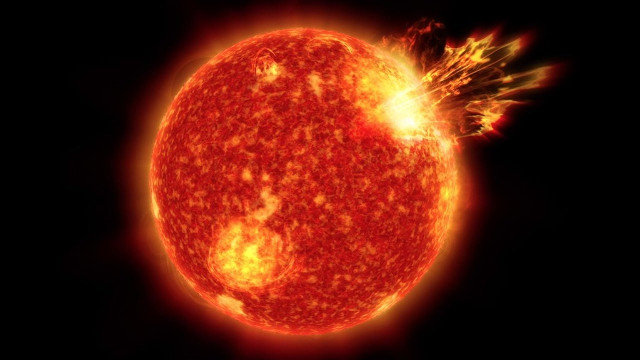
Artist's concept of what the Sun looked like 4 billion years ago (Image NASA's Goddard Space Flight Center/Conceptual Image Lab)

An article published in “The Astrophysical Journal” reports a study on the star Kappa 1 Ceti, very similar to the Sun in size and mass but much younger having an estimated age between 600 and 750 million years. A team of researchers coordinated by NASA’s Goddard Space Flight Center predicted some hard-to-measure features of Kappa 1 Ceti using computer models based on data collected by various NASA and ESA space telescopes. The results help to understand what the Sun looked like nearly four billion years ago, when it could emit superflares, to reconstruct the influence of its activity on early Earth and early life.

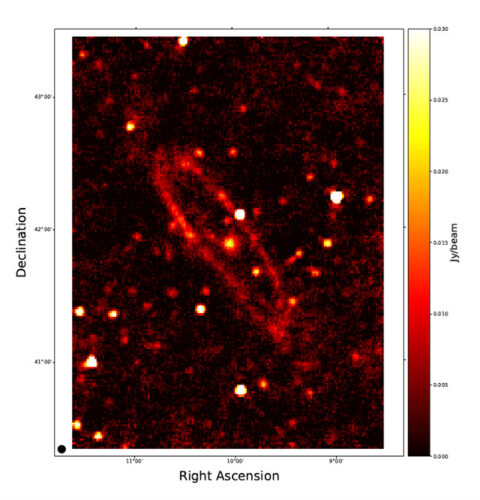
Andromeda seen from the Sardinia Radio Telescope

An article published in the journal “Astronomy & Astrophysics” reports a study on the Andromeda galaxy based on the best image captured in the microwave band. A team of researchers coordinated by Professor Elia Battistelli of the physics department at Sapienza used the Sardinia Radio Telescope (SRT) and its ability to work at high radio frequencies to create a map of Andromeda at 6.6 GHz, a frequency detected for the first time that fills a gap in the studies of the galaxy considered a sort of sister of the Milky Way. This helped to better understand the processes taking place within Andromeda identifying areas of star formation.