Stars

The supernova 2018zd, in the white circle on the right, near the galaxy NGC 2146

An article published in the journal “Nature Astronomy” reports a study on the supernova 2018zd. A team of researchers studied observations conducted with various telescopes and concluded that this supernova is of the electron-capture type, which was theorized 40 years ago but never identified with certainty. According to the researchers, 2018zd matches the theoretical predictions and offers new confirmations to the hypothesis that the supernova observed in A.D. 1054 was of the electron-capture type.

RCW 49 (Image NASA/JPL-Caltec/E.Churchwell (University of Wisconsin))

An article published in “The Astrophysical Journal” reports a study concerning a stellar nursery inside the RCW 49 nebula. A team of researchers coordinated by the University of Maryland used data obtained with the SOFIA flying telescope and combined them with others obtained with other instruments to obtain a 3D reconstruction of a gigantic structure of ionized hot plasma that is expanding around the open star cluster Westerlund 2. The main “suspect” behind that expansion is the star WR 20a.

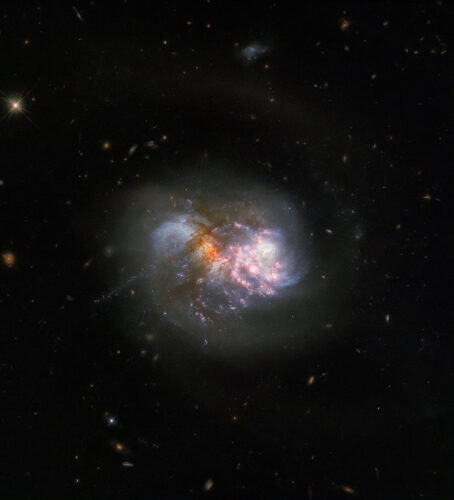
The IC 1623 pair seen by Hubble (Image ESA/Hubble & NASA, R. Chandar)

A new image captured by the Hubble Space Telescope shows a pair of galaxies in an advanced phase of merger cataloged as IC 1623. The filters used for the Wide Field Camera 3 (WFC3) instrument that captured the image allow seeing the differences between the two galaxies that are merging. This process can still continue for millions of years, so it will take who knows how long before a new galaxy is formed. Meanwhile, astronomers expect gas pushed by gravitational interactions to trigger a new star formation in what will subsequently be referred to as a starburst galaxy.

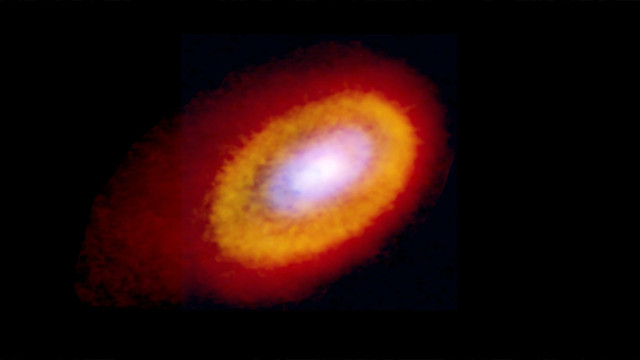
The Elias 2-27 system seen by ALMA

Two articles, one published in “The Astrophysical Journal” and one in “The Astrophysical Journal Letters”, report various aspects of a study of the protoplanetary disk surrounding the young star Elias 2-27. Two teams of researchers with various members in common and Teresa Paneque CarreƱo as principal investigator used the ALMA radio telescope to study that star system in formation. In particular, they studied the gravitational perturbations that generated the spiral arms in the disk. This is a step forward in understanding the mechanisms of formation of new planets.

Some of the galaxies observed in the PHANGS project

An article accepted for publication in the “Astrophysical Journal Supplement” series presents the PHANGS-ALMA survey with the mapping of about 100,000 stellar nurseries in 90 galaxies in the nearby universe. A team of researchers used the ALMA radio telescope to map molecular clouds of gas and dust in which conditions are suitable for the formation of new stars. The results of this survey were presented at the 238th meeting of the American Astronomical Society held in recent days.