Stars

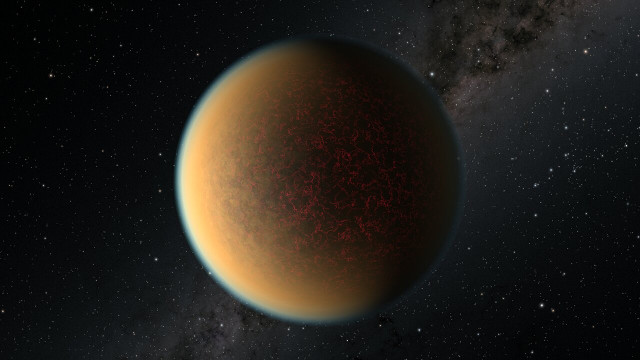
An artist’s impression of the exoplanet GJ 1132 b (Image NASA, ESA, and R. Hurt (IPAC/Caltech))

An article to be published in “The Astronomical Journal” reports a study on the atmosphere of the exoplanet GJ 1132 b which indicates that it may have lost its original atmosphere and that a new one was subsequently formed as a result of volcanic activity. A team of researchers led by Mark Swain of NASA’s Jet Propulsion Laboratory used observations conducted with the Hubble Space Telescope to detect the presence of an atmosphere containing hydrogen, hydrogen cyanide, methane, and ammonia with hydrocarbon hazes. According to the researchers, GJ 1132 b may have originated as a sub-Neptune, lost its original atmosphere because it’s very close to its star and therefore very hot, and what is now being detected is a new atmosphere generated by volcanic activity.

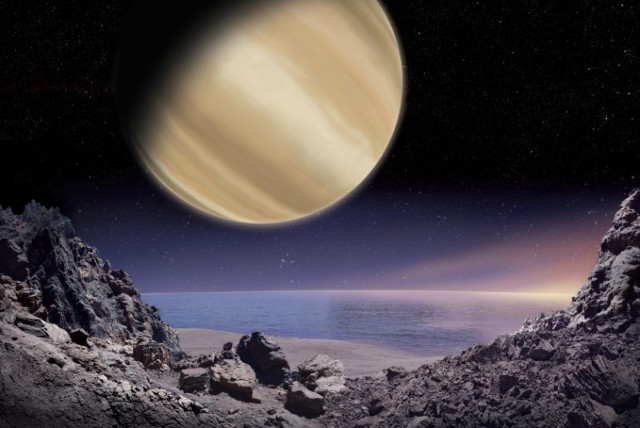
Artist's concept of Planet Pirx seen from a possible moon (Image courtesy M. Mizera / Pta / Iau100)

An article published in the journal “Astronomy and Astrophysics” reports the discovery of 26 planetary systems within the TAPAS (Tracking Advanced Planetary Systems) project. A team of researchers led by Professor Andrzej Niedzielski of the Institute of Astronomy at the NCU (Nicolaus Copernicus University) in Torun, Poland, used over a decade of observations with the Hobby-Eberly Telescope and the Galileo National Telescope to locate the traces of exoplanets around old stars, mostly now red giants, the last phase of their life. For their masses very similar to the Sun’s, three stars in particular have been defined as the Sun’s elder sisters.

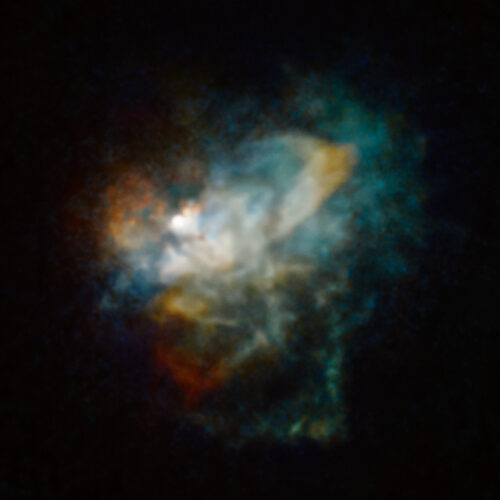
The nebula surrounding VY Canis Majoris seen by Hubble (Image NASA, ESA, and R. Humphreys (University of Minnesota), and J. Olmsted (STScI))

An article published in “The Astronomical Journal” reports a study on the dimming of the red hypergiant star VY Canis Majoris. A team of researchers led by astrophysicist Roberta Humphreys of the University of Minnesota, USA, used observations conducted with the Hubble Space Telescope to study not only the star but also huge clumps of materials around it. The conclusion is that VY Canis Majoris had moments where it ejected huge amounts of materials that formed those clumps and obscured it for various periods, detected over time.

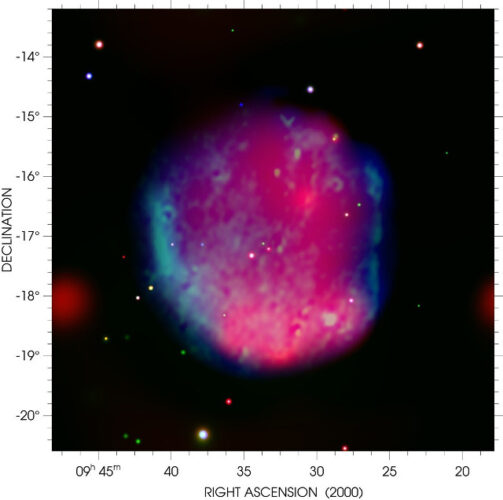
Hoinga in a composition of X-Ray and radio wave emissions

An article published in the journal “Astronomy & Astrophysics” reports the discovery of the largest supernova remnant in X-rays. A team of researchers used observations conducted with the Spektr-RG space telescope’s eROSITA instrument to create its first X-ray map of the sky to locate the traces of the supernova remnants that have been nicknamed Hoinga. The discovery was confirmed in radio frequency data from the CHIPASS survey conducted with the Parkes radio telescope.

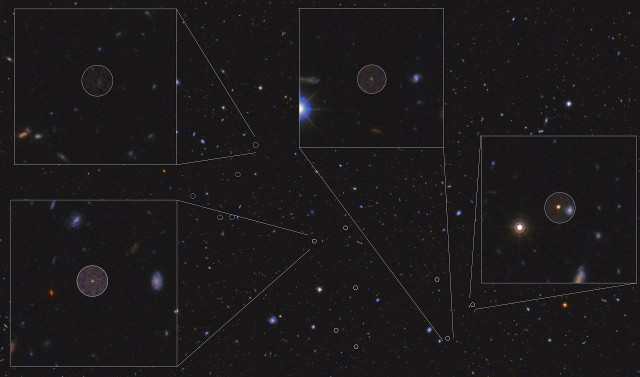
The galaxy cluster around HDF850.1

An article published in the journal “Monthly Notices of the Royal Astronomical Society” reports the discovery of the most densely populated galaxy cluster in formation in the early universe. A team of researchers used the OSIRIS instrument of the Gran Telescopio Canarias (GTC) to observe an area around the galaxy HDF850.1, already well known because it’s been the focus of various researches, discovering other protogalaxies. We see those galaxies as they were about 12.5 billion years ago, when the universe was very young, so this is a great discovery to study the birth and evolution of the largest structures in the universe.