Stars

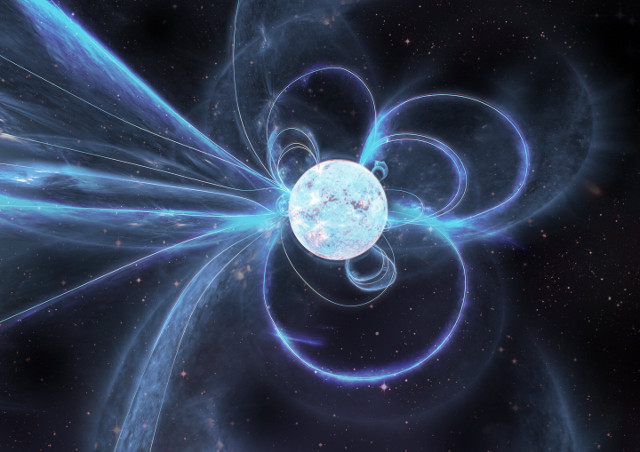
Artist's concept of Swift J1818.0-1607 with its magnetic field (Image courtesy OzGrav, Carl Knox)

An article published in the journal “Monthly Notices of the Royal Astronomical Society” reports a study on the magnetar Swift J1818.0-1607 that describes its behavior, more complex than expected. A team of researchers led by Marcus Lower of Swinburne University of Technology in Australia observed it between May and October 2020 with the Parkes radio telescope noting that its emissions varied from that of a magnetar to that of a pulsar, alternating typical behaviors of these two types of neutron stars. It eventually settled into the magnetar state, and that can offer insights into the evolution of these strange objects.

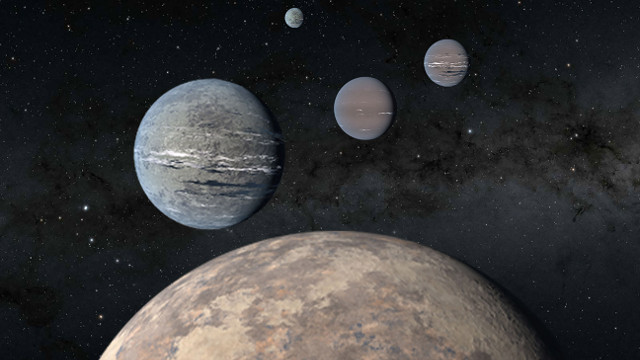
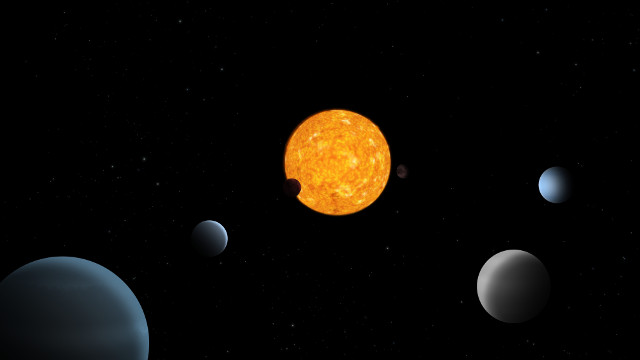
Artist's concept of the planets orbiting HD 108236 (Image NASA/JPL-Caltech)

An article published in “The Astronomical Journal” reports the confirmation of four exoplanets, one super-Earth and three mini-Neptunes, in the system of the star HD 108236. A team led by Tansu Daylan, postdoc Kavli Institute for Astrophysics and Space Research at MIT, analyzed data collected by NASA’s TESS space telescope to identify those exoplanets. Two high school students also participated in this research as part of the Student Research Mentoring Program (SRMP) at the Center for Astrophysics | Harvard & Smithsonian. An article accepted for publication in the journal “Astronomy & Astrophysics” reports the discovery of another super-Earth in the same system by a team of researchers led by Andrea Bonfanti of the Austrian Academy of Sciences that used ESA’s CHEOPS space telescope.

Artist’s impression of the TOI-178 planetary system (Image ESA)

An article published in the journal “Astronomy & Astrophysics” reports a study on the TOI-178 system that confirms the presence of six planets and indicates that the orbits of five of them are in resonance. A team of researchers led by Adrien Leleu of the Université de Genève and the University of Bern, Switzerland, used ESA’s CHEOPS space telescope and other instruments to confirm that there are at least six planets orbiting TOI-178. The result is a unique situation, with very different planets of which five follow a 2:4:6:9:12 resonance pattern.

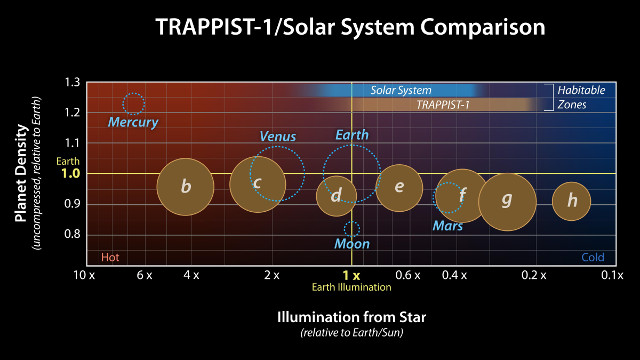
A comparison between the densities and illumination of the TRAPPIST-1 planets and the solar system's rocky planets with respect to Earth

An article published in the “Planetary Science Journal” reports a study on the seven planets of the ultra-cool dwarf star TRAPPIST-1’s system. A team of researchers led by astrophysicist Eric Agol of the University of Washington used data collected by the Spitzer Space Telescope over four years, by the Hubble and Kepler space telescopes, and by ground-based telescopes to obtain precise measurements of the planets’ masses and densities. The new calculations indicate that the seven planets have a very similar density, a new clue in the study of their composition with the possible similarities and differences compared to the rocky planets in the solar system.

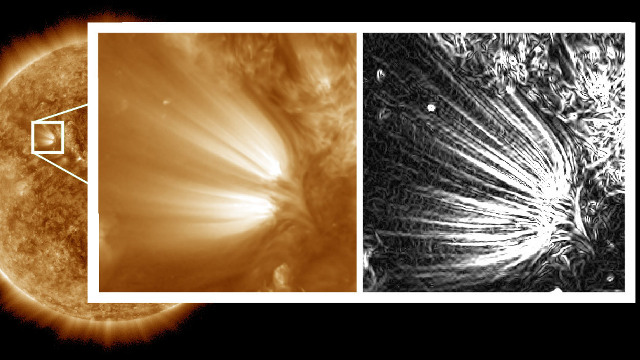
Sun's plumelets (Image NASA/SDO/Uritsky, et al)

An article published in “The Astrophysical Journal” reports a study on some structures that make up the solar plumes which are called plumelets in jargon. A team of researchers led by Vadim Uritsky of the Catholic University of America and NASA’s Goddard Space Flight Center applied cutting-edge image processing algorithms to NASA data to obtain unprecedented resolution images of solar plumelets. These structures are small but this study suggests they may play a crucial role in the solar wind, whose influence extends to the border with interstellar space.