Stars

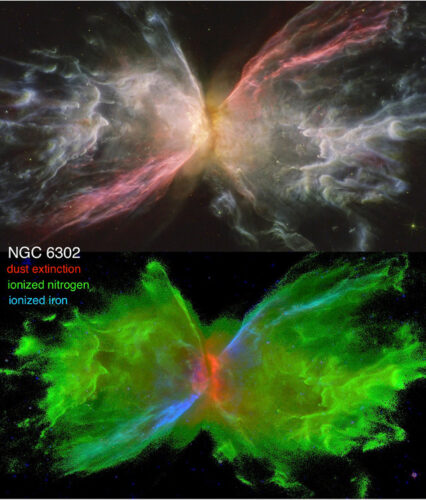
The planetary nebulae NGC 6302, also known as the Butterfly Nebula

At the 237th meeting of the American Astronomical Society, new data were presented regarding the planetary nebulae NGC 6302, also known as the Butterfly Nebula, and NGC 7027, also known as the Jewel Bug Nebula. A team of researchers used observations made with the Hubble Space Telescope at different wavelengths ranging from near-ultraviolet to near-infrared to study their properties. This made it possible to obtain new details that offer new insights into the ongoing processes in which dying stars are ejecting layers of ionized gas in a chaotic way.

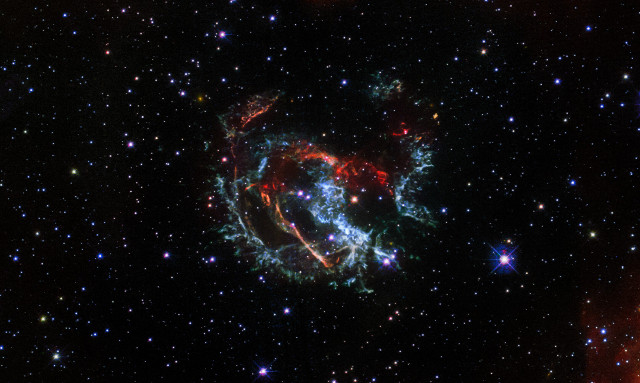
1E 0102.2-7219 (Image NASA, ESA, and J. Banovetz and D. Milisavljevic (Purdue University))

An article under review for publication reports a study on the supernova remnants cataloged as 1E 0102.2-7219 which estimate its place of origin and its age. A team of researchers led by John Banovetz and Danny Milisavljevic of Purdue University in West Lafayette, Indiana, USA, used observations conducted with the Hubble Space Telescope to reconstruct the history of that supernova that occurred in the Small Magellanic Cloud. The conclusion is that the light from the progenitor star’s explosion reached Earth about 1,700 years ago.

The galaxy ESO 253-G003 seen by the MUSE instrument (Michael Tucker (University of Hawai’i) and the AMUSING survey)

An article under review for publication reports a study on the galaxy ESO 253-G003 that classifies it among the ones with an active galactic nucleus that is consuming a star orbiting the central supermassive black hole. A team of researchers led by Anna Payne of the University of Hawaii used observations conducted with various telescopes to study the phenomenon, cataloged as ASASSN-14ko, detecting a series of regular cosmic outbursts that were interpreted as energy emissions linked to the passage of a star too close to the black hole, which destroys a part of it at each orbit.

Artist's representation of the galaxy ID2299 (Image ESO/M. Kornmesser)

An article published in the journal “Nature Astronomy” reports a study on a massive galaxy in the distant universe in which a galaxy merger appears to have inhibited star formation. A team of researchers led by Annagrazia Puglisi of Durham University’s Center for Extragalaxy Astronomy used the ALMA radio telescope to examine the galaxy cataloged as ID2299 and found star formation activity in its central regions while a huge amount of gas was ejected removing the possibility of forming new stars.

6 galaxy merger systems: at the top are the galaxies NGC 3256, NGC 1614, and NGC 4194; at the bottom are the galaxies NGC 3690, NGC 6052, and NGC 34.

An article published in the journal “Monthly Notices of the Royal Astronomical Society” reports a research on the star formation rate in galaxy merger systems. A team of researchers used observations carried out with the Hubble Space Telescope within the Hubble imaging Probe of Extreme Environments and Clusters (HiPEEC) survey to study the influence of a galaxy merger on star formation, particularly of entire star clusters. ESA has published a composition of six such systems.