Stars

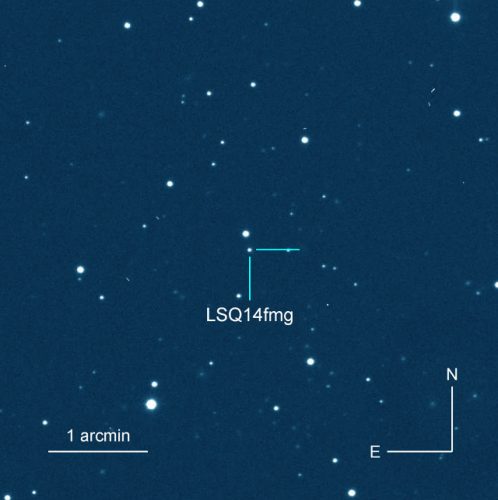
LSQ14fmg (Image courtesy Hsiao et al)

An article published in “The Astrophysical Journal” reports a study on the Type Ia supernova cataloged as LSQ14fmg, which became bright with considerable slowness but at some point became one of the brightest in its class. A team of researchers led by Eric Hsiao of Florida State University used observations conducted with telescopes in Chile and Spain to study its evolution. The conclusion is that the supernova was exploding inside what was an asymptotic giant branch (AGB) star and was caused by the merger of its core with a white dwarf orbiting inside it.

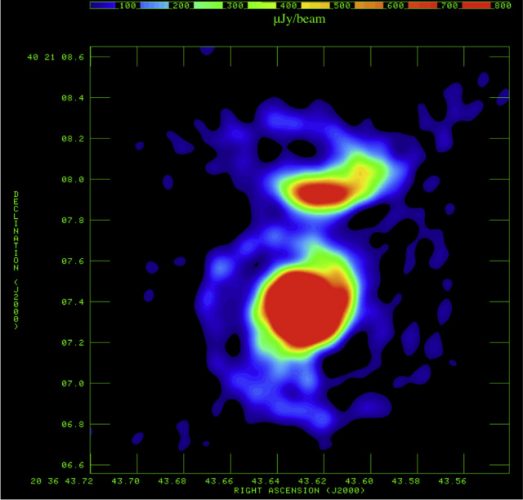
The WR 147 system seen by VLA

An article published in “The Astrophysical Journal Letters” reports a study of the WR 147 system, and in particular of one of the two stars that form it that is now reaching the end of its life, a massive star that is a very hot giant which belongs to the category of Wolf-Rayet stars. A team of researchers used the VLA radio telescope to study the radio emissions from this star, detecting very strong stellar winds colliding with those of its companion, another giant star but not yet at the end of its life. This phenomenon generates very powerful vortices of materials that look like cosmic pinwheels.

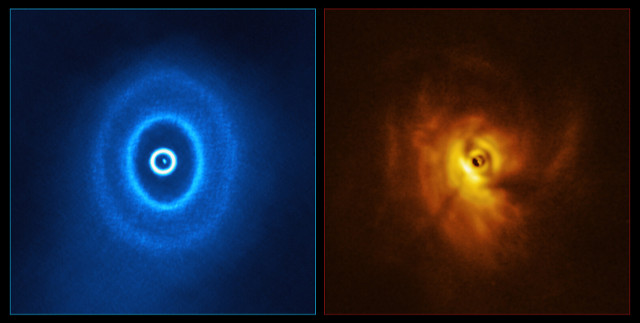
GW Orionis seen by ALMA and SPHERE (Image ALMA (ESO/NAOJ/NRAO), ESO/Exeter/Kraus et al.)

An article published in the journal “Science” reports a research on the characteristics of the circumstellar disk of the GW Orionis system, or GW Ori, warped by the action of the three stars that form it. A team of researchers used the AMBER and later GRAVITY and SPHERE instruments mounted on ESO’s VLTI and the ALMA radio telescope to observe the disk’s twisted shapes and the three rings into which it’s divided, which are misaligned. The innermost ring is made up of an amount of materials estimated to be about 30 times the Earth’s mass, so planets could form. The goal of the studies of this triple system is to understand if planets with stable orbits can form in its rings, a step forward to understand this type of processes in double or multiple systems.

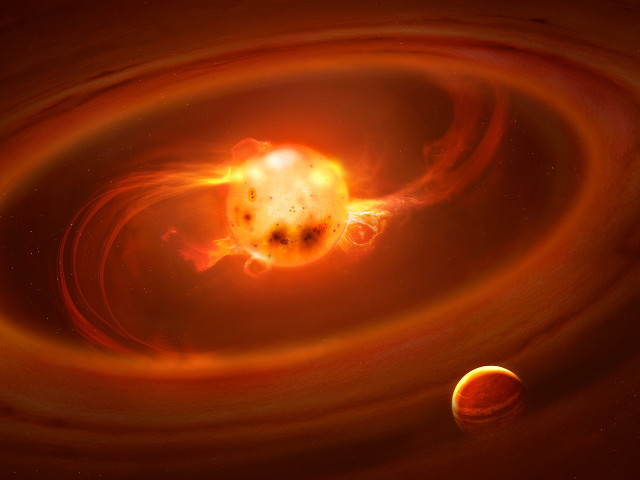
Artist's concept of a protostar attracting gas (Image courtesy A. Mark Garlick )

An article published in the journal “Nature” reports the results of observations of the very young TW Hydrae system in which for the first time the columns of materials that contribute to the formation of new stars have been directly observed. A team of researchers part of the GRAVITY collaboration that runs the instrument with that name mounted on ESO’s VLTI in Chile used it to obtain the best details ever studying TW Hydrae. This star has yet to complete its formation, so these observations provide new details on those processes.

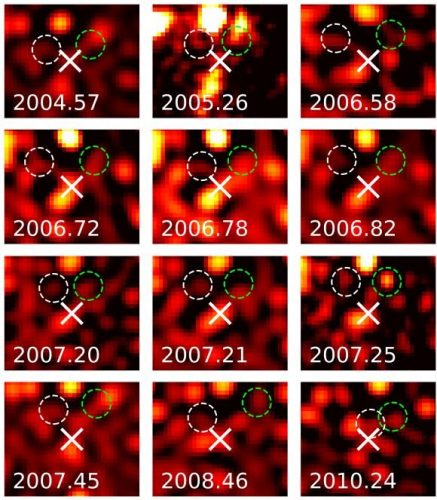
The star S4711 (Image courtesy Florian Peißker et al.)

Two articles published in “The Astrophysical Journal” report research on stars orbiting Sagittarius A*, or simply Sgr A*, the supermassive black hole at the center of the Milky Way, including the ones that reach the highest speed, S62 and S4714, and the one that goes through the orbit in the shortest time, S4711 in 7.6 Earth years. A team of researchers from the German University of Cologne led by Florian Peißker used observations made with the NACO and SINFONI instruments mounted on ESO’s VLT in Chile to track S62’s orbit. With the addition of two more researchers, the team also tracked the orbits of other stars in that area.