Stars

The area around the Per-emb-2 (IRAS 03292+3039) system, indicated by the box

An article published in the journal “Nature Astronomy” reports the first observation of a pair of protostars in the Perseus molecular cloud fed by a flow of gas and various compounds that formed in the parent cloud. A team of researchers led by Jaime Pineda of the Max Planck Institute for Extraterrestrial Physics (MPE) used the Northern Extended Millimeter Array (NOEMA) to study the protostellar binary system cataloged as Per-emb-2 (IRAS 03292+3039). They called that flow of gas and compounds a streamer tracing its movement from the boundaries of the parent cloud to its core, near the protostars. This also helps to better assess the importance of the local environment on the formation and evolution of disks in the systems in formation from which planets could be born.

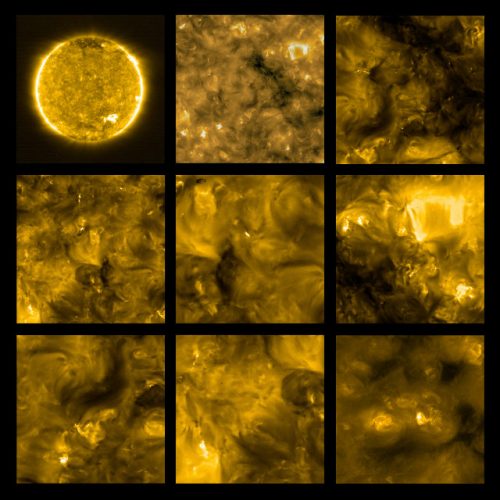
The Sun and its campfires seen by Solar Orbiter

ESA and NASA have published images captured by the Solar Orbiter space probe during its first Sun flyby. In this case, flying by means at a distance of about 77 million kilometers (48 million miles). During that maneuver, all its instruments were active after they were tested and commissioned despite the problems resulting from the Covid-19 pandemic with the difficulties for mission engineers and scientists. Among the first images, there are the ones of the so-called campfires, eruptions that are small by solar standards but are larger than many Earth nations.

The afterglow of GRB181123B seen by Gemini North (Image courtesy International Gemini Observatory/NOIRLab/NSF/AURA/K. Paterson & W. Fong (Northwestern University))

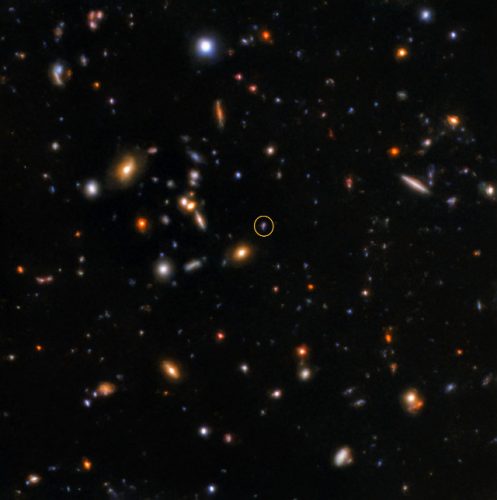
An article to be published in “The Astrophysical Journal Letters” reports a study of the short gamma-ray burst cataloged as GRB181123B focusing on the discovery of what in jargon is called afterglow, in short, the residues of the emissions of GRB181123B, which in this case were detected at optical frequencies as well. The estimates indicate that that event was generated around ten billion years ago making it the most distant ever detected with an optical afterglow. Probably the cause was a neutron star merger, so events of this type offer information on how long it took for them to occur and their amount at that time.

WISEA J181006.18-101000.5

An article published in “The Astrophysical Journal” reports the discovery of two brown dwarfs thanks to the help of citizen scientists who participated in the Backyard Worlds: Planet 9 program. Cataloged as WISEA J041451.67-585456.7 and WISEA J181006.18-101000.5, those are two objects with masses that fall within the range typical of brown dwarfs but with other characteristics more similar to those of gas giant planets. They could be the first extreme T-type subdwarfs, and resemble ancient exoplanets, with very little iron, having an estimated age of around 10 billion years. Their characteristics make them useful to better understand exoplanets.

Rho Ophiuchi cloud complex viewed by Herschel and Planck (Image ESA/Herschel/Planck; J. D. Soler, MPIA)

An article published in the journal “Astronomy & Astrophysics” reports a study of the magnetic fields of molecular clouds to understand their influence in the processes that lead to star formation. Astronomer Juan D. Soler of the Max Planck Institute for Astronomy in Heidelberg, Germany, used data collected by the Planck Surveyor space probe during its mission and the Herschel space telescope during the Gould Belt Survey to investigate the characteristics of the interstellar medium and especially molecular clouds. The study was published in 2019, but more spectacular images have been published by ESA of combined views of molecular clouds.