Stars

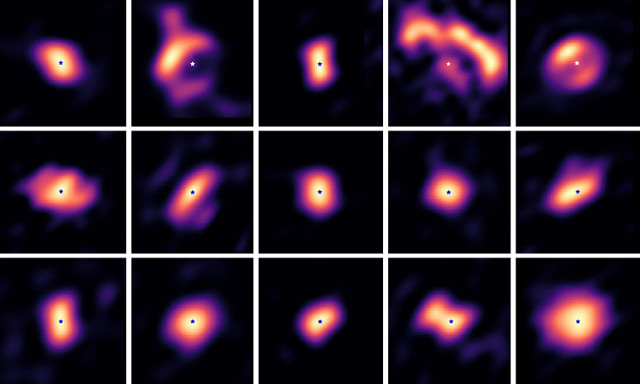
The 15 protoplanetary disks photographed by the VLTI

An article published in the journal “Astronomy & Astrophysics” reports the first case of high-resolution infrared observations of the internal areas of 15 protoplanetary disks performed by combining the four telescopes of the ESO VLT interferometer in Chile. A team of researchers led by Jacques Kluska of the Katholieke Universiteit Leuven in Belgium used the PIONIER instrument to achieve this result, which also shows traces of planetary formation. This type of observation offers new information on this process.

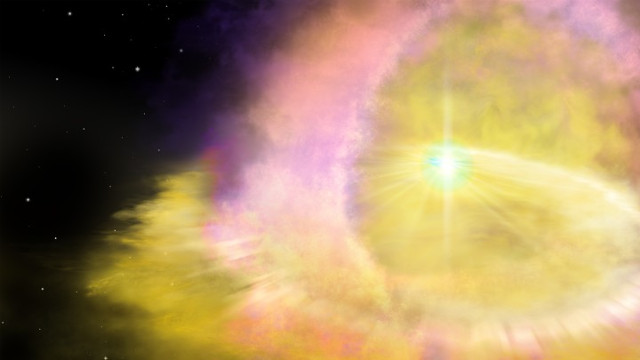
Artist's impression of a supernova (Image Aaron Geller (Northwestern University))

An article published in the journal “Nature Astronomy” reports a study on the supernova cataloged as SN2016aps, which was found to be at least twice as bright and probably much more massive than any other registered supernova. A team of astronomers led by Dr. Matt Nicholl of the British University of Birmingham observed the evolution of the supernova for about two years until it faded to 1% of its peak brightness. The conclusion is that the initial mass of the exploded star might have been even more than 100 times the Sun’s and this suggests that it was a very rare type called a pulsational pair-instability supernova.

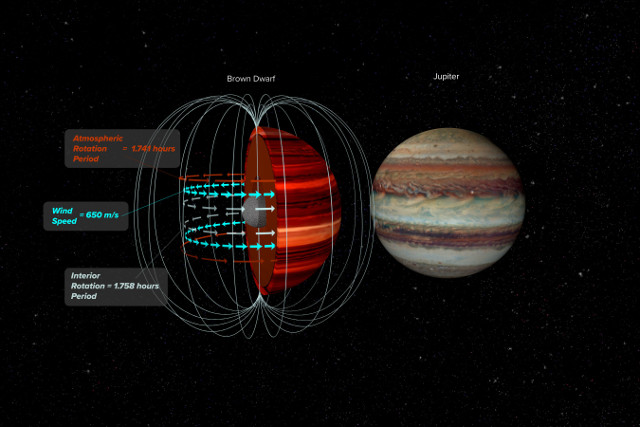
Illustration of brown dwarf and Jupiter

An article published in the journal “Science” reports the first measurement of the winds blowing in the atmosphere of the brown dwarf cataloged as 2MASS J10475385+2124234. A team of researchers led by Katelyn Allers of Bucknell University combined observations conducted with the Very Large Array (VLA) and NASA’s Spitzer space telescope to achieve this result. The method was already used for planets like Jupiter, so the news is its extension to a brown dwarf, and could also concern gaseous exoplanets.

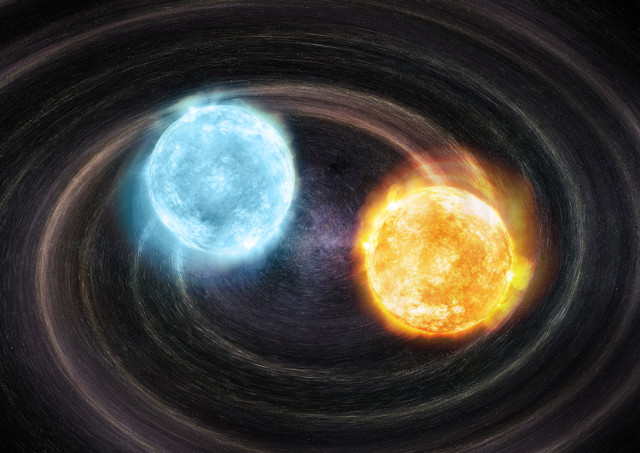
Artist's concept of white dwarf pair

An article to be published in the “Astrophysical Journal Letters” reports the discovery of a binary system formed by two white dwarfs with helium cores orbiting each other in 1201 seconds, one of the shortest orbital periods known in binary systems. A team of researchers led by astronomer Warren Brown of the Center for Astrophysics | Harvard & Smithsonian (Cfa) used data collected by ESA’s Gaia space probe and the Sloan Digital Sky Survey (SDSS) of the pair cataloged as SDSS J232230.20+050942.06, or simply J2322+0509, conducting follow-up observations with others instruments to examine their characteristics. It’s a possible source of gravitational that will be detected by the LISA sallite currently being designed by ESA.

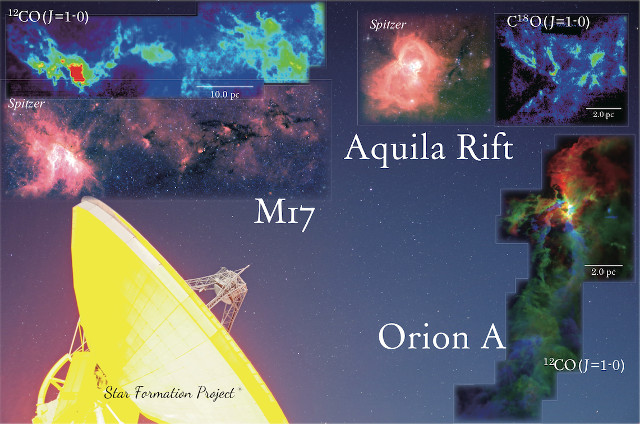
Star Formation Project montage

An article published in the journal “Publications of the Astronomical Society of Japan” reports the mapping of three interstellar clouds: Orion A, Aquila Rift, and M17. A team of researchers led by Professor Fumitaka Nakamura of the National Astronomical Observatory of Japan (NAOJ) used the Nobeyama radio telescope and for Orion A also data from the CARMA radio telescope array archive to achieve this result. This is an investigation not surprisingly called the Star Formation Project because the three interestellar clouds studied are nurseries for new stars.