Stars

Protostars in the Orion Complex

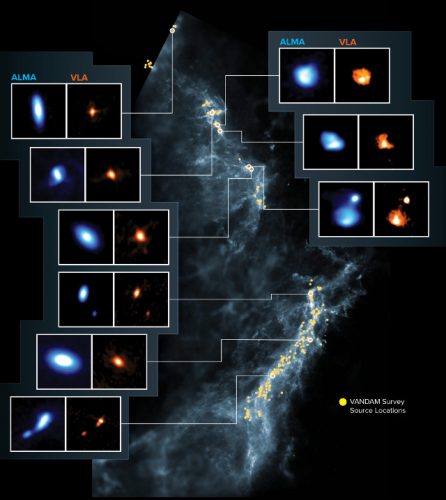
Two articles published in “The Astrophysical Journal” report the study of a total of over 300 protostars with their protoplanetary disks in the Orion Complex, a group of molecular clouds that are perfect nurseries for the birth of new stars. A team of researchers led by John Tobin of the National Radio Astronomy Observatory (NRAO) used the data collected by the VLA and ALMA radio telescopes during the VLA/ALMA Nascent Disk and Multiplicity (VANDAM) survey to identify the four youngest protostars in the Orion Complex. A team expanded with the addition of other researchers investigated 328 protostars identified in those molecular clouds.

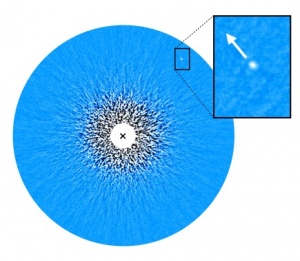
The brown dwarf GJ 504 B's system

An article published in “The Astronomical Journal” offers an explanation of the formation mechanisms of gas giant planets and brown dwarfs bringing evidence that these are two different mechanisms. A team of astronomers led by Brendan Bowler of the University of Texas, Austin, conducted observations at the Keck Observatory and with the Subaru Telescope, both in Hawaii, accompanied by computer simulations using the free / open source orbitize! software to try to understand if there were orbital differences that indicated a different origin between these objects. Their conclusion is that brown dwarfs have significantly more elliptical orbits.

The Solar Orbiter space probe blasting off atop an Atlas V rocket (Photo ESA - S. Corvaja)

A few hours ago the Solar Orbiter space probe blasted off atop an Atlas V rocket from Cape Canaveral. After about 53 minutes, it successfully separated from the rocket’s last stage and began the long journey that will take it up to about 42 million kilometers from the Sun. A little later it deployed its solar panels and started communicating with the mission control center.

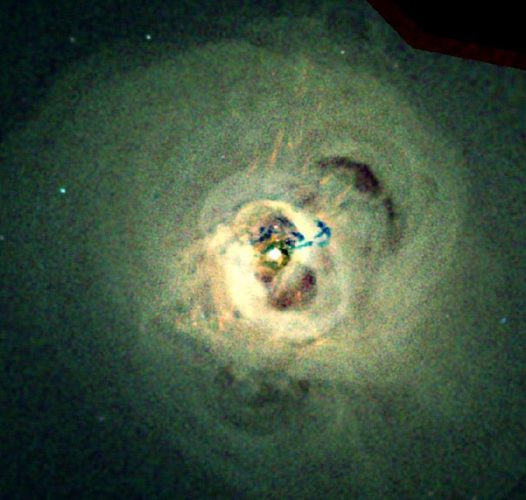
The center of the Perseus galaxy cluster (Image courtesy NASA/CXC/IoA/A.Fabian et al.)

An article published in the journal “Monthly Notices of the Royal Astronomical Society” reports the results of the study of molecular gas outflows in twelve massive galaxies at the center of galaxy clusters. A team of researchers analyzed data collected with the ALMA radio telescope to conduct this study finding that the active galactic nuclei (AGNs) of the observed galaxies cause periodic energy outbursts in the form of radiation or as jets of particles that move at speeds close to the speed of light. The energy releases cause gas outflows which can be pushed even beyond the galaxy borders. This mechanism limits the approach of the gas to the central supermassive black hole, decreasing the outbursts in what’s called a feedback. The researchers are especially studying the consequences on star formation and the possibility that a galaxy might become quenching.

The Tarantula Nebula (Image NASA/JPL-Caltech)

NASA has published a new image of the Tarantula Nebula, a region of the Large Magellanic Cloud, one of the Milky Way’s satellite dwarf galaxies. The image combines data from multiple observations conducted with the Spitzer space telescope, whose activity is about to cease. The Tarantula Nebula was one of the first targets studied with this instrument in 2003, after it was put into orbit, and demonstrated its capabilities. Once again, Spitzer offers a view of the structures existing in that area and above all of the many star formation processes taking place.