Stars

Artist's concept of the exoplanet KELT-9b (Image NASA/JPL-Caltech)

An article published in “The Astrophysical Journal Letters” reports a study of the exoplanet KELT-9b with evidence that the conditions are so extreme as to break hydrogen molecules. A team of researchers led by Megan Mansfield of the University of Chicago used NASA’s Spitzer space telescope to find evidence that KELT-9b is an extreme example even in the hot Jupiter planet class due to the conditions existing on its surface. Not accidentally, it’s the hottest known planet and on its dayside hydrogen molecules are broken and then recompose when the atoms move on its nightside.

A portion of the Subaru/XMM-Newton Deep Field with a dying galaxy in the middle (Image courtesy NAOJ/M. Tanaka)

Two articles, one published in “The Astrophysical Journal Letters” and one in “The Astrophysical Journal”, report the results of studies on ancient quenching galaxies, which means that they strongly reduced or even finished their star-formation activity. Two teams of researchers with many of them in common used data collected with various telescopes to study these galaxies and establish that we see the oldest as it was about 1.5 billion years after the Big Bang. These studies offer new information to improve galaxy formation models.

Artist's concept of protostar

An article published in the journal “Nature Astronomy” reports the observation of natural masers that revealed a heat wave in the protostar G358.93-0.03-MM1, or simply G358-MM1. A team of researchers led by Ross Burns of NAOJ (National Astronomical Observatory of Japan) carried out the detections as part of the M2O (Maser Monitoring Organization) network of astronomers, specialized in the study of astrophysical masers to understand their nature. In the specific case, it’s a massive protostar and the heat wave coming from it confirms that this type of star passes through a non-linear formation process.

Six so-called bloated stars confirmed at the center of the Milky Way

An article published in the journal “Nature” reports the identification of what were called G-objects that orbit the supermassive black hole at the center of the Milky Way, Sagittarius A* or simply Sgr A*. A team of researchers led by Anna Ciurlo of UCLA already announced the discovery of three new G-objects, now they confirm their existence and announce the identification of a fourth one. They add to the two G-objects already confirmed a few years ago. New indications could confirm the hypothesis that they’re the result of mergers of binary systems’ stars.

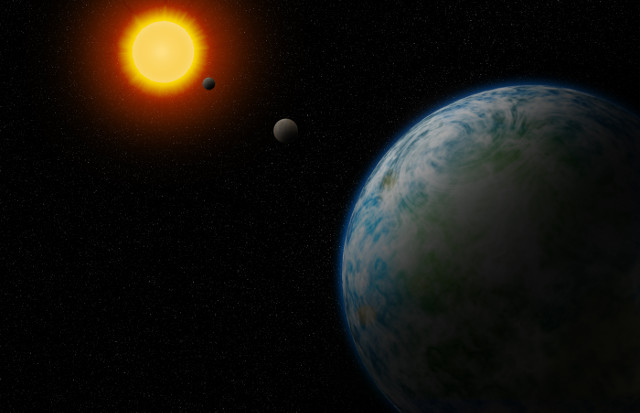
Artist's concept of the GJ180 system (Image Robin Dienel, courtesy of the Carnegie Institution for Science)

An article published in “The Astrophysical Journal Supplement Series” reports the identification of five new exoplanets, the detection of eight exoplanet candidates that will be verified, and the confirmation of three exoplanets previously detected but not yet confirmed. A team of astronomers led by Fabo Feng and Paul Butler of the Carnegie Institution for Science selected and reanalyzed data gathered in the survey conducted with the UVES instrument mounted on ESO’s VLT using other verification instruments. Two of the new exoplanets are super-Earths in their system’s habitable zone, the first of this type that orbit around red dwarfs not tidally locked,, a positive factor because having always day on one face and always night on the other generates extreme temperatures that lower the chances of life being born.