
Stars

New confirmations that phosphorus was brought to Earth by comets

An article to be published in the journal “Monthly Notices of the Royal Astronomical Society” reports a study tracing the journey of phosphorus from star formation to comets. A team of researchers led by Víctor Rivilla of the Italian National Institute of Astrophysics used the ALMA radio telescope and data collected by ESA’s Rosetta space probe’s ROSINA instrument on comet 67P/Churyumov–Gerasimenko to understand where phosphorus is formed and how comets may have brought it to Earth, where it’s needed by life forms.

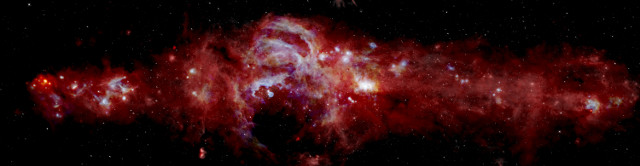
New details of the center of the Milky Way observed by the SOFIA flying telescope

An article submitted for publication in “The Astrophysical Journal” reports the initial results of an investigation about the center of the Milky Way conducted using the SOFIA flying telescope to capture infrared details never seen before and therefore useful for mapping an area 600 light years across. A team of researchers integrated those observations with data previously collected using NASA’s Spitzer space telescope and ESA’s Herschel space observatory obtaining a map of the center of the galaxy useful for example to understand where gas is concentrated which can lead to the new stars’ formation, how some of the most massive stars in the Milky Way formed in a relatively small region or where materials are likely to be devoured by the supermassive black hole at the center of the galaxy.

An analysis of wide binary stars shows that they're twins

An article accepted for publication in the journal “The Monthly Notices of the Royal Astronomical Society” reports a study on wide binary stars. A team of researchers led by Keith Hawkins of the University of Texas, Austin, studied 25 pairs of wide binary stars identified using data collected by ESA’s Gaia space probe. Using the Harlan J. Smith telescope at the McDonald Observatory, the researchers examined in depth the chemical composition of the 50 stars, concluding that stars born together show a practically identical chemical composition, much closer than randomly chosen stars of the same type.

NGC 2264 seen by Spitzer (Image Image Credit: NASA/JPL-Caltech/P.S. Teixeira (Center for Astrophysics))

NASA’s Spitzer space telescope captured a new image of the so-called Christmas Tree Cluster, so nicknamed for its shape. That appearance is enhanced by a remarkable star formation with the consequent presence of protostars that emit a light that appears pink or red to Spitzer that gives the area an effect similar to the Christmas tree’s balls. It’s part of a set of objects collectively known as NGC 2264 which also includes the Snowflake Cluster, the Cone Nebula and the Fox Fur Nebula.

A fragment of Muonionalusta meteorite

An article published in the journal “Nature Astronomy” reports an analysis of the isotopic composition of six groups of iron meteorites, and the results offer evidence that some of the materials that formed the planet Earth came from red giant stars. Mattias Ek of the University of Bristol, Alison C. Hunt, Maria Lugaro and Maria Schönbächler examined in particular the isotopic composition of palladium finding that some dust has a composition that can be produced only by nuclear reactions that take place in red giants’ inner regions. This offers an explanation of the greater presence of that type of dust on Earth than on Mars or in asteroids.