Stars

A gamma-ray burst from 2016 might have originated from a neutron star merger

An article published in the journal “Monthly Notices of the Royal Astronomical Society” reports a study on the short-duration gamma-ray burst cataloged as GRB160821B that has characteristics that match those of the merger of neutron stars observed at both electromagnetic waves and gravitational waves on August 17, 2017. A team of researchers led by Eleonora Troja of the University of Maryland used data collected from various telescopes to compare the two events and the 2016 one was observed since its early hours providing new information on the initial phase of what’s called a kilonova.

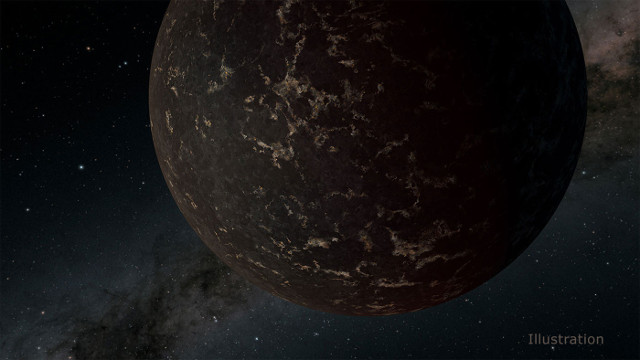
Artist's illustration of the exoplanet LHS 3844b (Image NASA/JPL-Caltech/R. Hurt (IPAC))

An article published in the journal “Nature” reports a study of the exoplanet LHS 3844b, a super-Earth discovered in 2018 thanks to NASA’s TESS space telescope. For this targeted study, a team of researchers led by Laura Kreidberg of the Harvard and Smithsonian Center for Astrophysics used the Spitzer space telescope to examine its surface and see if it had an atmosphere. The result is that LHS 3844b probably doesn’t have an atmosphere or it’s very thin and is perhaps covered by materials of volcanic origin such as the lunar “mare”. In essence, more than a super-Earth it could be a super-Mercury.

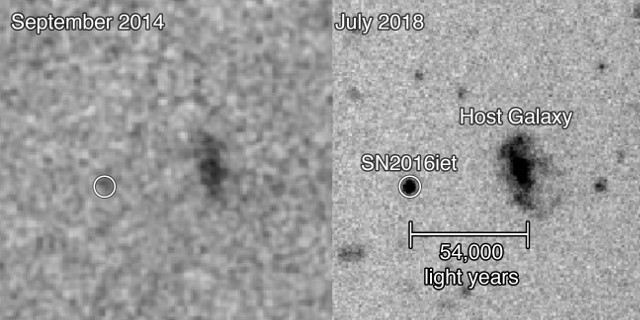
SN 2016iet is probably a pair-instability supernova

An article published in “The Astrophysical Journal” reports a study on the supernova SN 2016iet. A team of researchers used a number of telescopes to collect data on it. Almost three years of study have followed its first sighting, which happened on November 14, 2016, leading to estimate that the progenitor star had a mass about 200 times the Sun’s which exploded in what appears to be the first strong case of pair-instability supernova, which ends with the star’s total destruction.

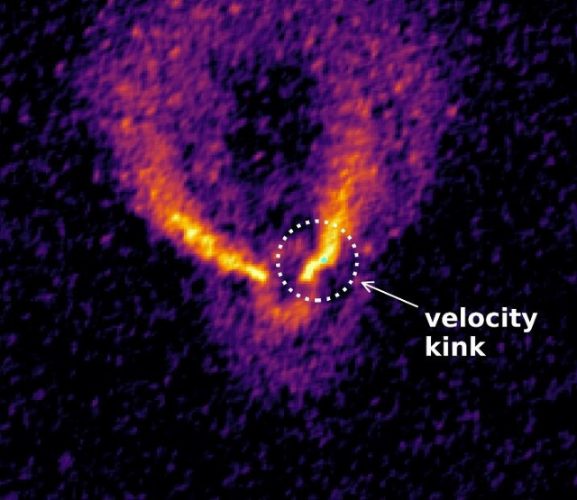
Planet's position pinpointed by the gas flow deviation (Image ESO/ALMA)

An article published in the journal “Nature Astronomy” reports the discovery of evidence of the existence of a planet in formation within the protoplanetary disk surrounding the star HD 97048. A team led by Christophe Pinte used a technique that was tested in a previous occasion that identifies areas where the flow of gas around a star is disturbed by the presence of a planet. The data collected using the ALMA radio telescope made it possible to identify a planet with a mass estimated between two and three times Jupiter’s.

The Vela Pulsar at the center of a nebula with the emission of a jet of particles (Image X-ray: NASA/CXC/Univ of Toronto/M.Durant et al; Optical: DSS/Davide De Martin)

An article published in the journal “Nature Astronomy” reports an analysis of an irregularity in the spin, a phenomenon called glitch in jargon, in the Vela Pulsar. A team of researchers led by Gregory Ashton of Monash University, Australia, analyzed the data collected by the Mount Pleasant Radio Observatory of the glitch detected on December 12, 2016. Probably this phenomenon is caused by internal interactions in the pulsar materials so studying it can provide information on the internal composition and on the processes taking place in an extreme object of this type.