Stars

Possible moons in formation around the exoplanet PDS 70 c

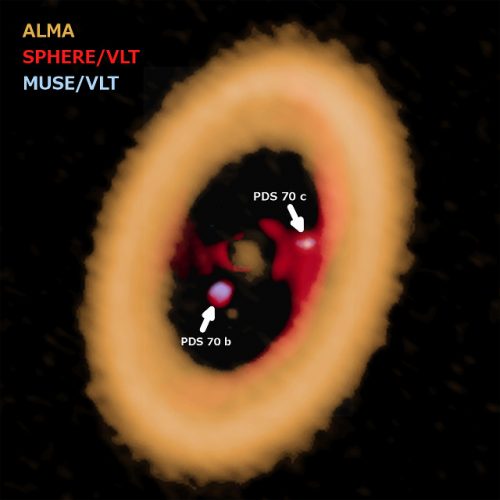
An article published in the journal “The Astrophysical Journal Letters” reports the observation of what is interpreted as a circumplanetary disk in the system of the young star PDS 70. A team of researchers led by Andrea Isella of Rice University in Houston, Texas, used the ALMA radio telescope to detect the emissions of that disk that surrounds the exoplanet PDS 70 c and according to the astronomers is of the type that controls the formation of planets and of a system of moons such as those around the planet Jupiter.

Using neutron star mergers to estimate the speed of the universe expansion

An article published in the journal “Nature Astronomy” reports the use of observations of the neutron stars merger recorded on August 17, 2017 to try to calculate the value of the Hubble constant, which measures the speed of the universe expansion. That event is the most famous of those recorded so far for gravitational waves due to the importance it had for the so-called multimessenger astronomy but it has already proved useful also to offer an additional way to measure the expansion of the universe that is alternative to the two that are providing a discrepancy in their results.

New details of the Eta Carinae system discovered in ultraviolet light

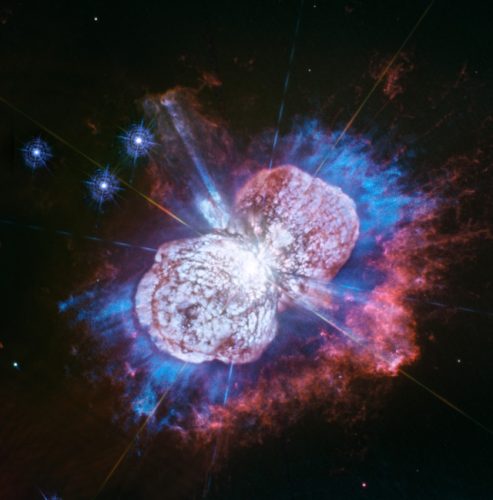
A new image of the Eta Carinae system captured by the Hubble space telescope offers new details of this truly special star system. The Wide Field Camera 3 (WFC3) instrument has in fact made it possible to observe the area in ultraviolet light as well revealing the glow of the magnesium embedded in the hot gas in places where it wasn’t seen before. Every new detail helps to understand the violent processes observed from the Earth for the past two centuries, since the event known as the Great Eruption began.

Three planets, one smaller than the Earth, discovered in the system of the red dwarf L 98-59

An article published in “The Astronomical Journal” reports the discovery of three planets that orbit the star L 98-59, a red dwarf about 35 light-years from Earth. A team of researchers led by Veselin Kostov of NASA’s Goddard Space Flight Center used observations from the TESS space telescope to discover the traces of the three exoplanets. The analysis showed that these are two possible super-Earths and the smallest planet discovered so far thanks to TESS, about 80% of the Earth. The three exoplanets are too close to their star to be in ​​their system’s habitable zone, instead they are in the area called “Venus zone”, where a planet’s atmosphere can heat up in a runaway greenhouse effect.

Two Earth-sized planets discovered in the nearby Teegarden's Star system

An article being published in the journal “Astronomy & Astrophysics” reports the discovery of two planets with a mass close to that of the Earth around Teegarden’s Star, a tiny star about 12.5 light years from Earth and therefore one of the closest. A team of researchers led by the German University of Göttingen used the CARMENES instrument mounted on the Spanish 3.6-meter telescope of the Calar Alto Observatory, Spain, to conduct one of the recent research focused on small stars.