Stars

The dwarf galaxy ESO 495-21 (Image ESA/Hubble, NASA)

An image captured by the Hubble space telescope shows the dwarf galaxy ESO 495-21, really small having an estimated total mass of around 10 billion solar masses, about 3% of the Milky Way. The astronomers’ interest in ESO 495-21 is due to the fact that, despite its small size, it’s of the starburst type, which means that it has a fast rate of star formation, and has at its center a supermassive black hole with a mass estimated at at least one million solar masses. It’s a case that could be similar to the first galaxies of the universe and supports the hypothesis that the dwarf galaxy formed around a black hole that already existed before.

A solution to the mystery of the formation of the exoplanet CI Tauri b

An article to be published in “Astrophysical Journal Letters” offers a solution to the mystery of the formation of the exoplanet CI Tauri b, a very young hot Jupiter that contradicts the models that predict that a gas giant is supposed to take at least 10 million years to form. A team of researchers used the IGRINS spectrograph to observe that exoplanet and the data collected suggest that it formed with the mechanism called hot start in jargon in which a gravitational instability is a key element in the quick formation of gas giant planets. Astronomers Christopher Johns-Krull of Rice University and Lisa Prato of the Lowell Observatory, among the authors of the research, presented these conclusions at the 234th meeting of the American Astronomical Society.

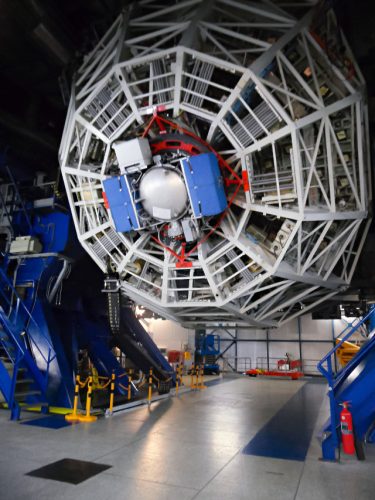
The NEAR instrument (Photo ESO/ NEAR Collaboration)

The NEAR (Near Earths in the AlphaCen Region) instrument mounted on the ESO VTL in Chile saw the so-called first light, which means that it made its first observation after being activated. This instrument is designed to detect exoplanets in the Alpha Centauri system, made up of two stars which, together with their farther and smaller companion Proxima, are the closest to the Sun at a distance of about 4.3 light years. ESO collaborated in this project with the Breakthrough Watch program.

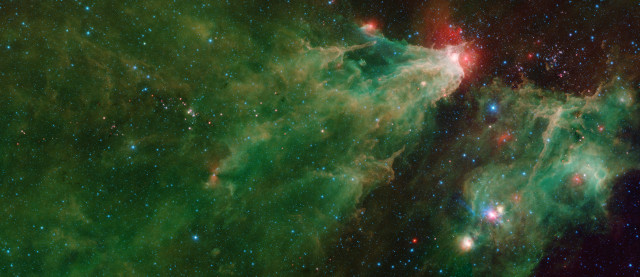
A stellar panorama between the Cepheus C and Cepheus B regions

An article published in “The Astrophysical Journal” reports a study of an area containing a number of star clusters that have a common origin even if their formation had slightly different timescales in the various regions. A team of researchers used NASA’s Spitzer space telescope and Chandra X-ray Observatory to examine the many different objects present between the regions known as Cepheus C and Cepheus B and map the cluster called Cep OB3b.

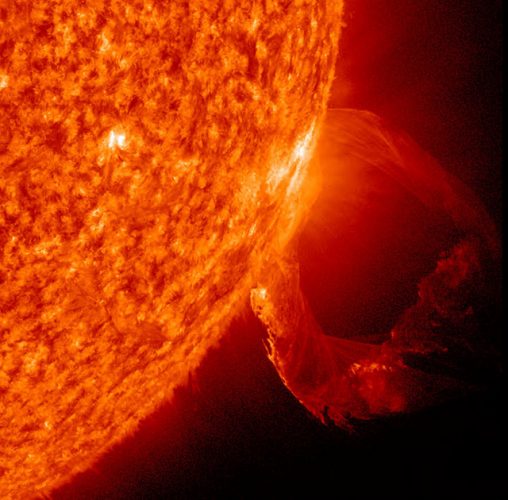
A solar eruption (Image SDO/NASA)

An article published in the journal “Nature Astronomy” reports the observation of a huge coronal mass ejection (CME), a huge stellar eruption in which an enormous amount of materials is thrown out, by the star HR 9024. A team of researchers led by Constance Argiroffi of the University of Palermo and associated of the National Institute of Astrophysics used data collected by NASA’s Chandra X-ray Observatory to find traces of the ejection of a mass about 10,000 times greater than that of the most powerful events of that kind generated by the Sun.